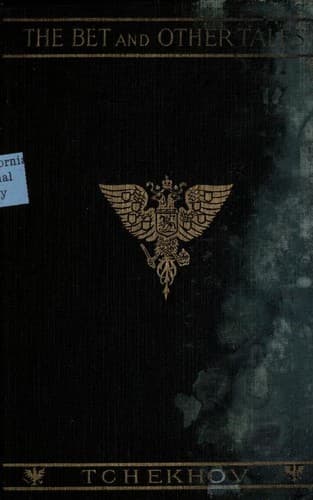
The Bet, and other storiesChekhov, Anton Pavlovich
General
The Bet, and other stories
Chekhov, Anton Pavlovich
Russian fiction -- Translations into English; Short stories, Russian -- Translations into English
Our dinner nowadays is as nasty to describe as to eat. On my wife’s
face there is pompousness, an assumed gravity, and the usual anxiety.
She eyes our plates nervously: “I see you don’t like the meat?...
Honestly, don’t you like it?” And I must answer, “Don’t worry, my dear.
The meat is very good.” She: “You’re always taking my part, Nicolai
Stiepanich. You never tell the truth. Why has Alexander Adolphovich
eaten so little?” and the same sort of conversation for the whole of
dinner. Liza laughs staccato and screws up her eyes. I look at both of
them, and at this moment at dinner here I can see quite clearly that
their inner lives have slipped out of my observation long ago. I feel
as though once upon a time I lived at home with a real family, but now
I am dining as a guest with an unreal wife and looking at an unreal
Liza. There has been an utter change in both of them, while I have lost
sight of the long process that led up to the change. No wonder I don’t
understand anything. What was the reason of the change? I don’t know.
Perhaps the only trouble is that God did not give my wife and daughter
the strength He gave me. From my childhood I have been accustomed to
resist outside influences and have been hardened enough. Such earthly
catastrophes as fame, being made General, the change from comfort to
living above my means, acquaintance with high society, have scarcely
touched me. I have survived safe and sound. But it all fell down like
an avalanche on my weak, unhardened wife and Liza, and crushed them.
Gnekker and the girls talk of fugues and counter-fugues; singers
and pianists, Bach and Brahms, and my wife, frightened of being
suspected of musical ignorance, smiles sympathetically and murmurs:
“Wonderful.... Is it possible?... Why?...” Gnekker eats steadily,
jokes gravely, and listens condescendingly to the ladies’ remarks. Now
and then he has the desire to talk bad French, and then he finds it
necessary for some unknown reason to address me magnificently, “Votre
Excellence.”
And I am morose. Apparently I embarrass them all and they embarrass me.
I never had any intimate acquaintance with class antagonism before,
but now something of the kind torments me indeed. I try to find only
bad traits in Gnekker. It does not take long and then I am tormented
because one of my friends has not taken his place as bridegroom. In
another way too his presence has a bad effect upon me. Usually, when
I am left alone with myself or when I am in the company of people I
love, I never think of my merits; and if I begin to think about them
they seem as trivial as though I had become a scholar only yesterday.
But in the presence of a man like Gnekker my merits appear to me like
an extremely high mountain, whose summit is lost in the clouds, while
Gnekkers move about the foot, so small as hardly to be seen.
Public-domain text, read in full here on John Shaqi.
Reviews
Reviews
No reviews yet
Be the first to share your thoughts on this work.
Join the Discussion
Join the discussion
Sign in to leave a comment or review.
Sign InorCreate an account