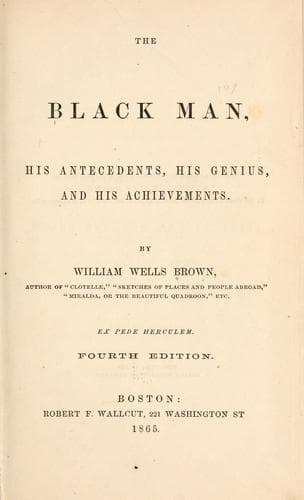
The Black Man: His Antecedents, His Genius, and His AchievementsBrown, William Wells
History
The Black Man: His Antecedents, His Genius, and His Achievements
Brown, William Wells
African Americans -- Biography
His advent as a lecturer was a remarkable one. White men and black men
had talked against slavery, but none had ever spoken like Frederick
Douglass. Throughout the north the newspapers were filled with the
sayings of the "eloquent fugitive." He often travelled with others,
but they were all lost sight of in the eagerness to hear Douglass. His
travelling companions would sometimes get angry, and would speak first
at the meetings; then they would take the last turn; but it was all
the same--the fugitive's impression was the one left upon the mind. He
made more persons angry, and pleased more, than any other man. He was
praised, and he was censured. He made them laugh, he made them weep,
and he made them swear. His "Slaveholder's Sermon" was always a trump
card. He awakened an interest in the hearts of thousands who before
were dead to the slave and his condition. Many kept away from his
lectures, fearing lest they should be converted against their will.
Young men and women, in those days of pro-slavery hatred, would return
to their fathers' roofs filled with admiration for the "runaway slave,"
and would be rebuked by hearing the old ones grumble out, "You'd better
stay at home and study your lessons, and not be running after the
nigger meetings."
In 1841, he was induced to accept an agency as a lecturer for the
Anti-slavery Society, and at once became one of the most valuable
of its advocates. He visited England in 1845. There he was kindly
received, and heartily welcomed; and after going through the length
and breadth of the land, and addressing public meetings out of number
on behalf of his countrymen in chains, with a power of eloquence which
captivated his auditors, and brought the cause which he pleaded home
to their hearts, he returned home and commenced the publication of the
_North Star_, a weekly newspaper devoted to the advocacy of the cause
of freedom.
Mr. Douglass is tall and well made. His vast and fully-developed
forehead shows at once that he is a superior man intellectually. He is
polished in his language, and gentlemanly in his manners. His voice is
full and sonorous. His attitude is dignified, and his gesticulation is
full of noble simplicity. He is a man of lofty reason; natural, and
without pretension; always master of himself; brilliant in the art of
exposing and abstracting. Few persons can handle a subject, with which
they are familiar, better than he. There is a kind of eloquence issuing
from the depth of the soul as from a spring, rolling along its copious
floods, sweeping all before it, overwhelming by its very force,
carrying, upsetting, ingulfing its adversaries, and more dazzling and
more thundering than the bolt which leaps from crag to crag. This is
the eloquence of Frederick Douglass. One of the best mimics of the age,
and possessing great dramatic powers, had he taken up the sock and
buskin, instead of becoming a lecturer, he would have made as fine a
Coriolanus as ever trod the stage.
Public-domain text, read in full here on John Shaqi.
Reviews
Reviews
No reviews yet
Be the first to share your thoughts on this work.
Elsewhere in the archive
Join the Discussion
Join the discussion
Sign in to leave a comment or review.
Sign InorCreate an account