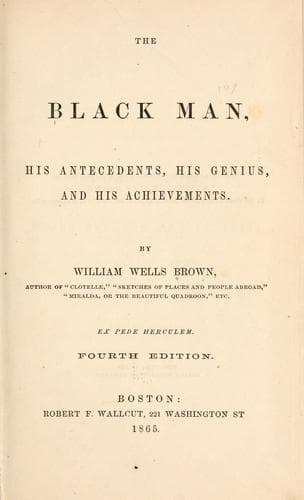
The Black Man: His Antecedents, His Genius, and His AchievementsBrown, William Wells
History
The Black Man: His Antecedents, His Genius, and His Achievements
Brown, William Wells
African Americans -- Biography
In his splendidly conceived comparison of Mr. Douglass to S. R. Ward,
written for the "Autographs for Freedom," Professor William J. Wilson
says of the former, "In his very look, his gesture, his whole manner,
there is so much of genuine, earnest eloquence, that they leave no
time for reflection. Now you are reminded of one rushing down some
fearful steep, bidding you follow; now on some delightful stream,
still beckoning you onward. In either case, no matter what your
prepossessions or oppositions, you, for the moment at least, forget the
justness or unjustness of his cause, and obey the summons, and loath,
if at all, you return to your former post. Not always, however, is he
successful in retaining you. Giddy as you may be with the descent you
have made, delighted as you are with the pleasure afforded, with the
Elysium to which he has wafted you, you return too often dissatisfied
with his and your own impetuosity and want of firmness. You feel that
you had only a dream, a pastime,--not a reality.
"This great power of momentary captivation consists in his eloquence
of manners, his just appreciation of words. In listening to him, your
whole soul is fired, every nerve strung, every passion inflated, and
every faculty you possess ready to perform at a moment's bidding.
You stop not to ask why or wherefore. 'Tis a unison of mighty yet
harmonious sounds that play upon your imagination; and you give
yourself up, for a time, to their irresistible charm. At last, the
_cataract_ which roared around you is hushed, the _tornado_ is passed,
and you find yourself sitting upon a bank, (at whose base roll but
tranquil waters,) quietly asking yourself why, amid such a display of
power, no greater effect had really been produced. After all, it must
be admitted there is a power in Mr. Douglass rarely to be found in any
other man."
As a speaker, Frederick Douglass has had more imitators than almost
any other American, save, perhaps, Wendell Phillips. Unlike most
great speakers, he is a superior writer also. Some of his articles,
in point of ability, will rank with any thing ever written for the
American press. He has taken lessons from the best of teachers, amid
the homeliest realities of life; hence the perpetual freshness of his
delineations, which are never over-colored, never strained, never
aiming at difficult or impossible effects, but which always read like
living transcripts of experience. The following from his pen, on "What
shall be done with the slaves, if emancipated?" is characteristic of
his style.
Public-domain text, read in full here on John Shaqi.
Reviews
Reviews
No reviews yet
Be the first to share your thoughts on this work.
Elsewhere in the archive
Join the Discussion
Join the discussion
Sign in to leave a comment or review.
Sign InorCreate an account