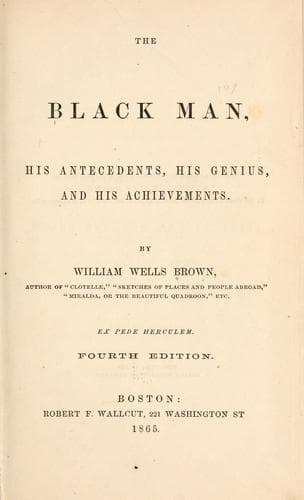
The Black Man: His Antecedents, His Genius, and His AchievementsBrown, William Wells
History
The Black Man: His Antecedents, His Genius, and His Achievements
Brown, William Wells
African Americans -- Biography
No man is more respected in the Assembly than Mr. Jordan, and reform
measures offered by him are often carried through the house, owing to
the respect the members have for the introducer. In the year 1860, the
honorable gentleman was elevated to the dignity of knighthood by the
Queen. Sir Edward Jordan has ever been regarded as an honest, upright,
and temperate man. In a literary point of view, he is considered one of
the first men in Jamaica.
It is indeed a cheering sign for the negro to look at one of his race,
who, a few years ago, was tried for his life in a city in which he is
now the chief magistrate, inspector of the prison in which he was once
incarcerated, and occupying a seat in the legislature by the side of
the white man who ejected him from his position as a clerk, on account
of his color. To those who say that the two races cannot live in peace
together, we point to the Jamaica Assembly, with more than half of its
members colored; and to all who think that the negro is only fit for
servitude, we reply by saying, Look at Sir Edward Jordan.
JOSEPH CARTER.
The subject of this sketch is a native of the city of Bridgetown,
Barbadoes, where he was born on the 16th of February, 1831. At the
early age of eleven years, he was apprenticed to William Howell, a
cabinet-maker of his native place. The boy showed so much genius and
skill even at this tender age, that he excited an interest in his
behalf, which culminated in his becoming the ward of Miss Hayes, a
talented lady, of English origin, whose guardianship of young Carter
did much to pave the way for the development of his hidden powers.
In his seventeenth year, Joseph came to the States in company with
his guardian, and settled in the city of Philadelphia, where he now
resides. Buoyant with hopes, knowing his own capacity, and aspiring in
his nature, the young man went forth in search of employment, little
dreaming of the insurmountable prejudice which every man of his color
has to meet in this country, and more especially in cities in the
border states. In vain he went from shop to shop, appealing for simple
justice, feeling confident that if once in employment, he could keep
his situation by his ability as a workman. Wherever he appeared before
a manufacturer, the reply was, "I would hire you if my hands, who are
white, would not leave me." This calls to mind an incident that was
related to me by a master gilder in Sixth Street, Philadelphia, a
few years since. I had stepped into his place to purchase a picture
frame, when, on learning that I was from Boston, he inquired if I was
acquainted with Jacob R. Andrews. I replied that I was. "Then," said
he, "do you see that bench there?" "Yes." "There was where he learned
his trade." "Was he apprenticed to you?" I inquired. "No," said he;
"he came to me, wishing to learn the business: my men refused to work
in the same room with him, although he was as white as most of them.
Public-domain text, read in full here on John Shaqi.
Reviews
Reviews
No reviews yet
Be the first to share your thoughts on this work.
Elsewhere in the archive
Join the Discussion
Join the discussion
Sign in to leave a comment or review.
Sign InorCreate an account