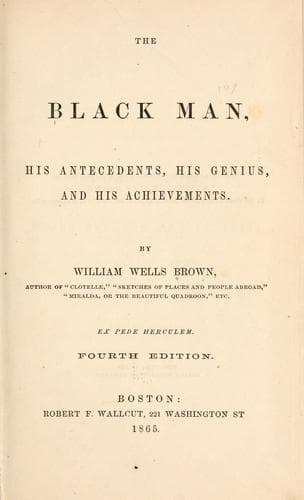
The Black Man: His Antecedents, His Genius, and His AchievementsBrown, William Wells
History
The Black Man: His Antecedents, His Genius, and His Achievements
Brown, William Wells
African Americans -- Biography
The announcement that a regiment of colored soldiers was to be raised
in Massachusetts, created another sensation among the Copperheads,
and no means were left unused to deter them from enlisting. An early
prejudice was brought against the movement, owing to the fact that
the commissioned officers were white, and no door was to be opened
to the black man's elevation. Would colored men enlist under such
restrictions? was a question asked in every circle. All admitted that
they had no inducement, save that of a wish to aid in freeing their
brethren of the south.
Disfranchised in a majority of the free states, laboring under an
inhuman and withering prejudice, shut out of the political, religious,
and social associations of the nation, the black man's case was a hard
one. In the past, every weapon that genius or ignorance could invent or
command had been turned against him. Missiles had been hurled at his
devoted head from every quarter.
The pulpit, the platform, and the press, had all united against him.
The statesman in the councils of the nation had lowered his standard
in his attempts to dehumanize the negro; the scholar had forgotten
his calling while turning aside to coin epithets against the race.
All of this he would have to forget before he could accept the musket
and the knapsack. Yet he did forget all, and in a few short days
the Massachusetts fifty-fourth regiment stood before the country as
another evidence of the black man's fidelity and patriotism. It is but
simple justice to say of this regiment, that the adjutant general,
on its departure for the seat of war, paid it the high compliment of
being the most sober and well behaved, and of having cost less for its
organization, than any regiment that had left the commonwealth, and
that it was better drilled than all, except the twelfth. While the
fifty-fourth, by its military skill and good order, was softening the
hard hearts of the people north, the negro regiments of Louisiana were
attracting attention by the boldness of their request to General Banks
to be sent to the field of active duty, and to be put in the front of
the fight.
When New Orleans was captured by General Butler, he found there a
regiment of colored men bearing the name of the "Native Guard." These
men had been compelled to serve under the rebels; but when the latter
left the city, the former refused to follow, and embraced the earliest
opportunity to offer their services to the Union cause. They were at
once accepted by General Butler, under the title of the first Louisiana
regiment.
Public-domain text, read in full here on John Shaqi.
Reviews
Reviews
No reviews yet
Be the first to share your thoughts on this work.
Elsewhere in the archive
Join the Discussion
Join the discussion
Sign in to leave a comment or review.
Sign InorCreate an account