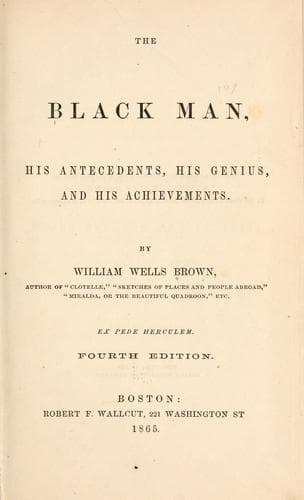
The Black Man: His Antecedents, His Genius, and His AchievementsBrown, William Wells
History
The Black Man: His Antecedents, His Genius, and His Achievements
Brown, William Wells
African Americans -- Biography
Already the blacks on this continent, though kept
down under the heel of the white man, are fast rising in the scale
of intellectual development, and proving their equality with the
brotherhood of man.
In his address before the Colonization Society, at Washington, on
the 18th of January, 1853, Hon. Edward Everett said, "When I lived
in Cambridge, a few years ago, I used to attend, as one of the board
of visitors, the examinations of a classical school, in which was a
colored boy, the son of a slave in Mississippi, I think. He appeared
to me to be of pure African blood. There were at the same time two
youths from Georgia, and one of my own sons, attending the same school.
I must say that this poor negro boy, Beverly Williams, was one of the
best scholars at the school, and in the Latin language he was the best
scholar in his class. There are others, I am told, which show still
more conclusively the aptitude of the colored race for _every kind of
intellectual culture_."
Mr. Everett cited several other instances which had fallen under his
notice, and utterly scouted the idea that there was any general
inferiority of the African race. He said, "They have done as well as
persons of European or Anglo-American origin would have done, after
three thousand years of similar depression and hardship. The question
has been asked, 'Does not the negro labor under some incurable, natural
inferiority?' _In this, for myself, I have no belief._"
I think that this is ample refutation of the charge of the natural
inferiority of the negro. President Lincoln, in the interview to which
I have already referred, said, "But for your race among us there would
not be a war." This reminds me of an incident that occurred while
travelling in the State of Ohio, in 1844. Taking the stage coach at a
small village, one of the passengers (a white man) objected to my being
allowed a seat inside, on account of my color. I persisted, however, in
claiming the right which my ticket gave me, and got in. The objector at
once took a seat on a trunk on the top of the coach. The wire netting
round the top of the stage not being strong, the white passenger,
trunks and all, slid off as we were going down a steep hill. The top
passenger's shoulder was dislocated, and in his pain he cried out, "If
you had not been black, I should not have left my seat inside."
Public-domain text, read in full here on John Shaqi.
Reviews
Reviews
No reviews yet
Be the first to share your thoughts on this work.
Join the Discussion
Join the discussion
Sign in to leave a comment or review.
Sign InorCreate an account