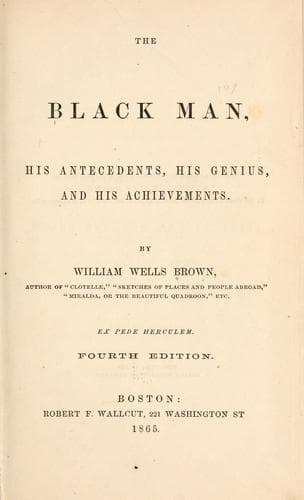
The Black Man: His Antecedents, His Genius, and His AchievementsBrown, William Wells
History
The Black Man: His Antecedents, His Genius, and His Achievements
Brown, William Wells
African Americans -- Biography
The "New York Herald," the "Boston Post," the "Boston Courier," and
the "New York Journal of Commerce," take the lead in misrepresenting
the effect which emancipation in the West Indies had upon the welfare
of those islands. It is asserted that general ruin followed the
black man's liberation. As to the British colonies, the fact is well
established that slavery had impoverished the soil, demoralized the
people, bond and free, brought the planters to a state of bankruptcy,
and all the islands to ruin, long before Parliament had passed the act
of emancipation. All the colonies, including Jamaica, had petitioned
the home government for assistance, ten years prior to the liberation
of their slaves. It is a noticeable fact, that the free blacks were the
least embarrassed, in a pecuniary point of view, and that they appeared
in more comfortable circumstances than the whites. There was a large
proportion of free blacks in each of the colonies, Jamaica alone having
fifty-five thousand before the day of emancipation. A large majority
of the West India estates were owned by persons residing in Europe,
and who had never seen the colonies. These plantations were carried on
by agents, overseers, and clerks, whose mismanagement, together with
the blighting influence which chattel slavery takes with it wherever
it goes, brought the islands under impending ruin, and many of the
estates were mortgaged in Europe for more than their value. One man
alone, Neil Malcomb, of London, had forty plantations to fall upon
his hands for money advanced on them before the abolition of slavery.
These European proprietors, despairing of getting any returns from the
West Indies, gladly pocketed their share of the twenty million pounds
sterling, which the home government gave them, and abandoned their
estates to their ruin. Other proprietors residing in the colonies
formed combinations to make the emancipated people labor for scarcely
enough to purchase food for them. If found idle, the tread-wheel, the
chain-gang, the dungeon, with black bread, and water from the moat, and
other modes of legalized torture, were inflicted upon the negroes.
Through the determined and combined efforts of the land owners, the
condition of the freed people was as bad, if not worse, for the first
three years after their liberation, than it was before. Never was an
experiment more severely tested than that of emancipation in the West
Indies.
Public-domain text, read in full here on John Shaqi.
Reviews
Reviews
No reviews yet
Be the first to share your thoughts on this work.
Join the Discussion
Join the discussion
Sign in to leave a comment or review.
Sign InorCreate an account