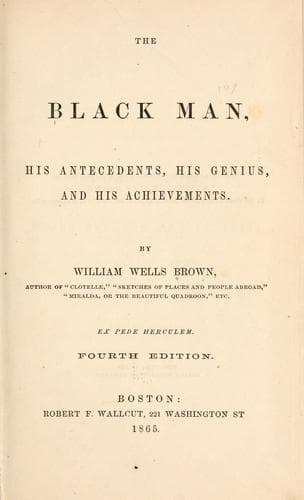
The Black Man: His Antecedents, His Genius, and His AchievementsBrown, William Wells
History
The Black Man: His Antecedents, His Genius, and His Achievements
Brown, William Wells
African Americans -- Biography
But one of the clearest demonstrations of the ability of the slave
to provide for himself in a state of freedom is to be found in the
prosperous condition of the large free colored population of the
Southern States. Maryland has eighty thousand, Virginia seventy
thousand, and the other slave states have a large number. These free
people have all been slaves, or they are the descendants of those who
were once slaves; what they have gained has been acquired in spite of
the public opinion and laws of the south, in spite of prejudice, and
every thing. They have acquired a large amount of property; and it
is this industry, this sobriety, this intelligence, and this wealth
of the free colored people of the south, that has created so much
prejudice on the part of slaveholders against them. They have felt
that the very presence of a colored man, looking so genteelly and in
such a prosperous condition, made the slaves unhappy and discontented.
In the Southern Rights Convention which assembled at Baltimore, June
8, 1860, a resolution was adopted, calling on the legislature to pass
a law driving the free colored people out of the state. Nearly every
speaker took the ground that the free colored people must be driven out
to make the slave's obedience more secure. Judge Mason, in his speech,
said, "It is the thrifty and well-to-do free negroes, that are seen by
our slaves, that make them dissatisfied." A similar appeal was made to
the legislature of Tennessee. Judge Catron, of the Supreme Court of
the United States, in a long and able letter to the Nashville "Union,"
opposed the driving out of the colored people. He said they were
among the best mechanics, the best artisans, and the most industrious
laborers in the state, and that to drive them out would be an injury
to the state itself. This is certainly good evidence in their behalf.
The New Orleans "True Delta" opposed the passage of a similar law by
the State of Louisiana. Among other things it said, "There are a large
free colored population here, correct in their general deportment,
honorable in their intercourse with society, and free from reproach so
far as the laws are concerned, not surpassed in the inoffensiveness
of their lives by any equal number of persons in any place, north or
south."
A movement was made in the legislature of South Carolina to expel
the free blacks from that state, and a committee was appointed to
investigate the matter. In their report the committee said, "We find
that the free blacks of this state are among our most industrious
people; in this city (Charleston) we find that they own over two and a
half millions of dollars worth of property; that they pay two thousand
seven hundred dollars tax to the city."
Public-domain text, read in full here on John Shaqi.
Reviews
Reviews
No reviews yet
Be the first to share your thoughts on this work.
Join the Discussion
Join the discussion
Sign in to leave a comment or review.
Sign InorCreate an account