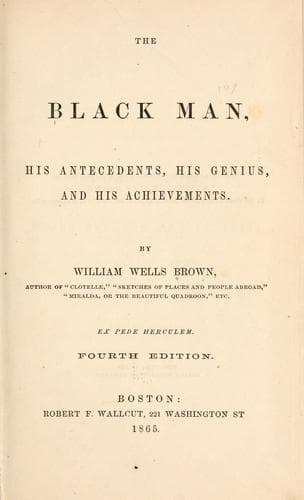
The Black Man: His Antecedents, His Genius, and His AchievementsBrown, William Wells
History
The Black Man: His Antecedents, His Genius, and His Achievements
Brown, William Wells
African Americans -- Biography
Such were the outraged feelings of a people whose ancestors had been
ruthlessly torn from their native land, and sold in the shambles of St.
Domingo. To terrify the blacks and convince them that they could never
be free, the planters were murdering them on every hand by thousands.
The struggle in St. Domingo was watched with intense interest by the
friends of the blacks, both in Paris and in London, and all appeared
to look with hope to the rising up of a black chief, who should prove
himself adequate to the emergency. Nor did they look in vain. In the
midst of the disorders that threatened on all sides, the negro chief
made his appearance in the person of a slave, named Toussaint. This man
was the grandson of the King of Ardra, one of the most powerful and
wealthy monarchs on the west coast of Africa. By his own energy and
perseverance, Toussaint had learned to read and write, and was held in
high consideration by the surrounding planters as well as their slaves.
His private virtues were many, and he had a deep and pervading
sense of religion, and in the camp carried it even as far as Oliver
Cromwell. Toussaint was born on the island, and was fifty years of age
when called into the field. One of his chief characteristics was his
humanity.
Before taking any part in the revolution, he aided his master's family
to escape from the impending danger. After seeing them beyond the reach
of the revolutionary movement, he entered the army as an inferior
officer, but was soon made aid-de-camp to General Bissou. Disorder and
bloodshed reigned throughout the island, and every day brought fresh
intelligence of depredations committed by whites, mulattoes, and blacks.
Such was the condition of affairs when a decree was passed by the
Colonial Assembly giving equal rights to the mulattoes, and asking
their aid in restoring order and reducing the slaves again to their
chains. Overcome by this decree, and having gained all they wished, the
free colored men joined the planters in a murderous crusade against the
slaves. This union of the whites and mulattoes to prevent the bondman
getting his freedom, created an ill feeling between the two proscribed
classes which seventy years have not been able to efface. The French
government sent a second army to St. Domingo, to enforce the laws
giving freedom to the slaves; and Toussaint joined it on its arrival in
the island, and fought bravely against the planters.
While the people of St. Domingo were thus fighting amongst themselves,
the revolutionary movement in France had fallen into the hands of
Robespierre and Danton, and the guillotine was beheading its thousands
daily. When the news of the death of Louis XVI. reached St. Domingo,
Toussaint and his companions left the French, and joined the Spanish
army in the eastern part of the island, and fought for the king of
Spain. Here Toussaint was made brigadier general, and appeared in the
field as the most determined foe of the French planters.
Public-domain text, read in full here on John Shaqi.
Reviews
Reviews
No reviews yet
Be the first to share your thoughts on this work.
Elsewhere in the archive
Join the Discussion
Join the discussion
Sign in to leave a comment or review.
Sign InorCreate an account