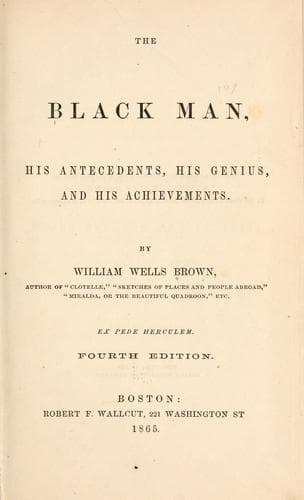
The Black Man: His Antecedents, His Genius, and His AchievementsBrown, William Wells
History
The Black Man: His Antecedents, His Genius, and His Achievements
Brown, William Wells
African Americans -- Biography
The two armies met; a battle was fought in the streets, and many
thousands were slain on both sides; the planters, however, were
defeated. During the conflict the city was set on fire, and on every
side presented shocking evidence of slaughter, conflagration, and
pillage. The strifes of political and religious partisanship, which
had raged in the clubs and streets of Paris, were transplanted to
St. Domingo, where they raged with all the heat of a tropical clime
and the animosities of a civil war. Truly did the flames of the
French revolution at Paris, and the ignorance and self-will of the
planters, set the island of St. Domingo on fire. The commissioners,
with their retinue, retired from the burning city into the neighboring
highlands, where a camp was formed to protect the ruined town from the
opposing party. Having no confidence in the planters, and fearing a
reaction, the commissioners proclaimed a general emancipation to the
slave population, and invited the blacks who had joined the Spaniards
to return. Toussaint and his followers accepted the invitation,
returned, and were enrolled in the army under the commissioners. Fresh
troops arrived from France, who were no sooner in the island than
they separated--some siding with the planters, and others with the
commissioners. The white republicans of the mother country arrayed
themselves against the white republicans of St. Domingo, whom they
were sent out to assist; the blacks and the mulattoes were at war with
each other; old and young, of both sexes and of all colors, were put
to the sword, while the fury of the flames swept from plantation to
plantation and from town to town.
During these sad commotions, Toussaint, by his superior knowledge of
the character of his race, his humanity, generosity, and courage,
had gained the confidence of all whom he had under his command. The
rapidity with which he travelled from post to post astonished every
one. By his genius and surpassing activity, Toussaint levied fresh
forces, raised the reputation of the army, and drove the English and
Spanish from the island.
With the termination of this struggle every vestige of slavery and all
obstacles to freedom disappeared. Toussaint exerted every nerve to make
Hayti what it had formerly been. He did every thing in his power to
promote agriculture; and in this he succeeded beyond the most sanguine
expectations of the friends of freedom, both in England and France.
Even the planters who had remained on the island acknowledged the
prosperity of Hayti under the governorship of the man whose best days
had been spent in slavery.
The peace of Amiens left Bonaparte without a rival on the continent,
and with a large and experienced army, which he feared to keep idle;
and he determined to send a part of it to St. Domingo.
Public-domain text, read in full here on John Shaqi.
Reviews
Reviews
No reviews yet
Be the first to share your thoughts on this work.
Elsewhere in the archive
Join the Discussion
Join the discussion
Sign in to leave a comment or review.
Sign InorCreate an account