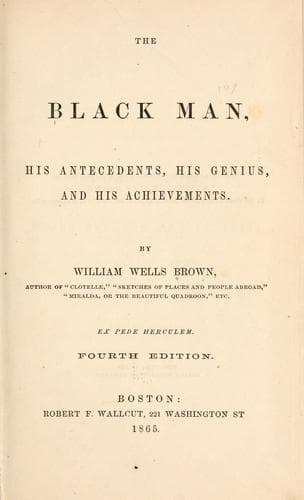
The Black Man: His Antecedents, His Genius, and His AchievementsBrown, William Wells
History
The Black Man: His Antecedents, His Genius, and His Achievements
Brown, William Wells
African Americans -- Biography
After the conversation had ceased, and the preacher gone out to call
on Mrs. Daniels, Mrs. Young said to the maid, "Now, Hannah, brother
Pinchen is gone; you get the cowhide, and I'll whip you well, for
aggravating me as you did to-day. It seems as if I can never sit down
to take a little comfort with the Lord, without the devil putting it
into your head to cross me. I've no doubt, Hannah, that I'll miss
going to heaven on your account; but I'll whip you well before I leave
this world--that I will." The servant received a flogging, Mrs. Young
felt easier, and I was in the kitchen amusing my fellow-slaves with
telling over Mr. Pinchen's last experience. Here let me say, that
we regarded the religious profession of the whites around us as a
farce, and our master and mistress, together with their guest, as mere
hypocrites. During the entire visit of the preacher, the servants had a
joyful time over my representations of what was going on in the great
house.
The removal of my master's family and slaves to the centre of the State
of Missouri about this time, caused some change in our condition. My
young master, William, had now grown to be a stout boy of five years
of age. No restraint thrown around him by the doctor or his wife, aunt
Dolly, his nurse, not permitted to control any of his actions, William
had become impudent, petulant, peevish, and cruel. Sitting at the
tea table, he would often desire to make his entire meal out of the
sweetmeats, the sugar-bowl, or the cake; and when mistress would not
allow him to have them, he, in a fit of anger, would throw any thing
within his reach at me; spoons, knives, forks, and dishes would be
hurled at my head, accompanied with language such as would astonish any
one not well versed in the injurious effects of slavery upon the rising
generation. Thomas Jefferson, in 1788, in a letter to M. Warville,
Paris, writing upon slavery, alludes to its influence upon the young as
follows:--
"The parent storms, the child looks on, catches the lineaments of
wrath, puts on the same airs in the circle of smaller slaves, GIVES
LOOSE TO HIS WORST PASSIONS; and, thus _nursed, educated, and daily
exercised in tyranny_, cannot but be stamped by it with odious
peculiarities."
In the Virginia legislature, in the year 1832, Hon. Lewis Summers
said,--
"A slave population exercises the _most pernicious influence_ upon the
manners, habits, and character of those among whom it exists. _Lisping
infancy_ learns the vocabulary of abusive epithets, and struts, the
_embryo tyrant_ of its little domain. The consciousness of _superior
destiny_ takes possession of his mind at its earliest dawning, and
_love of power and rule_ 'grows with his growth and strengthens with
his strength.' Unless enabled to rise above the operation of those
powerful causes, _he enters the world with miserable notions of
self-importance, and under the government of an unbridled temper_."
Public-domain text, read in full here on John Shaqi.
Reviews
Reviews
No reviews yet
Be the first to share your thoughts on this work.
Join the Discussion
Join the discussion
Sign in to leave a comment or review.
Sign InorCreate an account