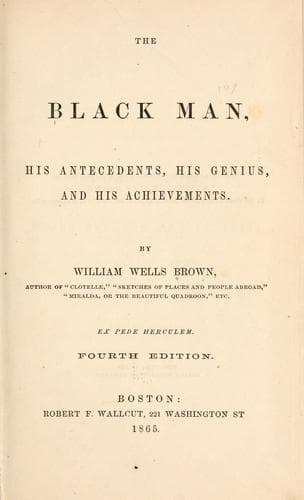
The Black Man: His Antecedents, His Genius, and His AchievementsBrown, William Wells
History
The Black Man: His Antecedents, His Genius, and His Achievements
Brown, William Wells
African Americans -- Biography
Having, by speculation and mismanagement, lost the most of his
property, Dr. Young resumed the practice of medicine in Missouri, and
soon obtained a lucrative run of custom. Here, as in Kentucky, the
doctor took great interest in matters of religion, and was considered
one of the pillars in the church.
Being sent one Sabbath morning to carry the sacramental wine to the
church, about a mile distant, I could not withstand the temptation it
presented of tasting it. Having had one swallow, I was tempted further
on, till the beverage disappeared out of the neck of the bottle, so
that I felt afraid that if noticed by master, I should be flogged. It
occurred to me that I might fill up the bottle from one of the sap
tubs, as I passed through the sugar camp; for it was the spring of the
year, and we were making maple sugar. I tried to pour the sap into the
bottle, but it flared over the top, leaving the wine still some inches
down the neck. After ransacking my inventive faculties, I fortunately
hit upon a plan and filled it up. Placing the bottle on the ground, and
sucking my mouth full of the juice, I stood directly over the bottle
and let it stream in until it was full. Putting the stopple in, I
started off towards the church, feeling that I had got the advantage of
master once more.
My fair complexion was a great obstacle to my happiness, both with
whites and blacks, in and about the great house. Often mistaken by
strangers for a white boy, it annoyed my mistress very much. On one
occasion, a visitor came to the place in the absence of the doctor.
While Mrs. Young was entertaining the major (for he was a military
man), I passed through the room, and going near the stranger, he put
out his hand and said to me, "How do you do, bub?" and turning to the
lady, he exclaimed, "Madam, I would have known that he was the doctor's
son, if I had met him in California, for he is so much like his papa."
Mistress ordered me out of the room, and remarked that I was one of
the servants, when the major begged pardon for the mistake. After the
stranger was gone, I was flogged for his blunder.
Dr. Young sold his large farm, which was situated in the central part
of the state, and removed to St. Louis, where a number of the servants
were let out. I was put to work tending upon the hands in the office
of the "St. Louis Times," a newspaper owned and published by Lovejoy
& Miller, and edited by Elijah P. Lovejoy. Here my young heart began
to feel more longings for liberty. The love of freedom is a sentiment
natural to the human heart, and the want of it is felt by him who does
not possess it. He feels it a reproach; and with this sting, this
wounded pride, hating degradation, and looking forward to the cravings
of the heart, the enslaved is always on the alert for an opportunity
to escape from his oppressors and to avenge his wrongs. What greater
injury and indignity can be offered to man, than to make him the
bond-slave of his fellow-man?
Public-domain text, read in full here on John Shaqi.
Reviews
Reviews
No reviews yet
Be the first to share your thoughts on this work.
Join the Discussion
Join the discussion
Sign in to leave a comment or review.
Sign InorCreate an account