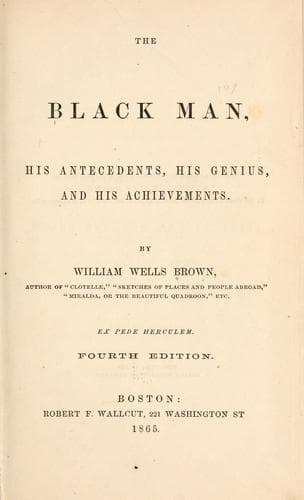
The Black Man: His Antecedents, His Genius, and His AchievementsBrown, William Wells
History
The Black Man: His Antecedents, His Genius, and His Achievements
Brown, William Wells
African Americans -- Biography
Cinque was a man of great intelligence and natural ability; he was
a powerful orator, and although speaking in a tongue foreign to his
audience, by the grace and energy of his motions and attitudes, the
changeful expression of his features, and the intonations of his
voice, made them understand the main incidents of his narrative, and
swayed their minds in an extraordinary manner. Alluding to that point
of his history at which Cinque described how, when on board the Spanish
vessel, he, with the help of a nail, first relieved himself of his
manacles, then assisted his countrymen to get rid of theirs, and then
led them to the attack of the Spaniards, Lewis Tappan, in the account
of the whole proceedings connected with the Amistad captives, which he
published, says, "It is not in my power to give an adequate description
of Cinque when he showed how he did this, and led his comrades to the
conflict, and achieved their freedom. In my younger years I have seen
Kemble and Siddons, and the representation of 'Othello,' at Covent
Garden; but no acting that I have ever witnessed came near that to
which I allude."
ALEXANDRE DUMAS.
I had been in Paris a week without seeing Dumas, for my letter of
introduction from Louis Blanc, who was then in exile in England, to
M. Eugene Sue, had availed me nothing as regarded a sight of the
great colored author. Sue had promised me that I should have an
interview with Dumas before I quitted the French capital; but I had
begun to suspect that the latter felt that it would be too much of
a condescension to give audience to an American slave, and I began
to grow indifferent myself upon the matter. Invited by a friend to
attend the opera, to witness the performances of Grisi and Mario, in
Norma, I gladly accepted, and in company with my friend started for
the place of amusement. Our seats were "reserved," and I took my place
in the immense saloon before raising my eyes to view the vast audience
which had already assembled. The splendid chandeliers, the hundreds of
brilliant gas lights, the highly-colored drapery that hung its rich
folds about the boxes and stalls, were in keeping with the magnificent
diamonds, laces, and jewelry, that adorned the persons of the finest
assembly that I had ever seen. In a double box nearly opposite to me,
containing a party of six or eight, I noticed a light-complexioned
mulatto, apparently about fifty years of age,--curly hair, full face,
dressed in a black coat, white vest, white kids,--who seemed to be
the centre of attraction, not only in his own circle, but in others.
Those in the pit looked up, those in the gallery looked down, while
curtains were drawn aside at other boxes and stalls to get a sight at
the colored man. So recently from America, where caste was so injurious
to my race, I began to think that it was his woolly head that attracted
attention, when I was informed that the mulatto before me was no less
a person than Alexandre Dumas. Every move, look, and gesture of the
Public-domain text, read in full here on John Shaqi.
Reviews
Reviews
No reviews yet
Be the first to share your thoughts on this work.
Elsewhere in the archive
Join the Discussion
Join the discussion
Sign in to leave a comment or review.
Sign InorCreate an account