Communism -- Soviet Union; Europe -- Social conditions -- 20th century; Socialism; World War, 1914-1918
Produced by Al Haines.
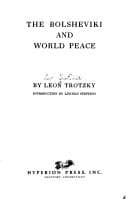
[Illustration: Cover]
[Illustration: Leon Trotzky]
THE BOLSHEVIKI
AND
WORLD PEACE
BY LEON TROTZKY
INTRODUCTION BY LINCOLN STEFFENS
BONI AND LIVERIGHT
NEW YORK
1918
Copyright
1918
Boni & Liveright Inc.
CONTENTS
Introduction by Lincoln Steffens
Author’s Preface
CHAPTER
I. The Balkan Question
II. Austria-Hungary
III. The War against Czarism
IV. The War against the West
V. The War of Defense
VI. What Have Socialists to do with Capitalist Wars?
VII. The Collapse of the International
VIII. Socialist Opportunism
IX. The Decline of the Revolutionary Spirit
X. Working Class Imperialism
XI. The Revolutionary Epoch
INTRODUCTION
The voice that speaks in this book is the voice of Leon Trotzky, the
Bolshevik Minister of Foreign Affairs for Revolutionary Russia. It is
expressing ideas and views which lighted him on the course of his policy
toward the War, Peace and the Revolution. It throws light, therefore,
on that policy; it helps to an understanding of it, if one wishes to
understand. But that isn’t all. The spirit that flames and casts
shadows upon these pages is not only Trotzky’s. It is the spirit also of
the Bolsheviki; of the red left of the left wing of the revolutionary
movement of New Russia. It flashed from Petrograd to Vladivostok, in
the first week of the revolt; it burned all along the Russian Front
before Trotzky appeared on the scene. It will smoulder long after he is
gone. It is a hot Fact which has to be picked up and examined, this
spirit. Whether we like it or don’t, it is there; in Russia; it is
elsewhere; it is everywhere to-day. It is the spirit of war; class war,
but war. It is in this book.
Nor is that all.
The mind in this book--the point of view from which it starts, the views
to which it points--Trotzky’s mind is the international mind. We have
heard before of this new intelligence; we have read books, heard
speeches, witnessed acts demonstrative of thoughts and feelings which
are not national, but international; not patriotic, but loyal only to
the lower-class-conscious war aims of the workers of the world. The
class warrior is as familiar a figure to us as the red spirit is of the
red left of revolution. But the voice which utters here the spirit and
the mind, not only of the Russian, but of the world revolution is the
voice of one having authority.
Public-domain text, read in full here on John Shaqi.
Reviews
Reviews
No reviews yet
Be the first to share your thoughts on this work.
Join the Discussion
Join the discussion
Sign in to leave a comment or review.
Sign InorCreate an account