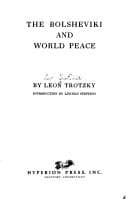
Communism -- Soviet Union; Europe -- Social conditions -- 20th century; Socialism; World War, 1914-1918
Nevertheless, it might be said in opposition to this that while the
ruling class in Germany has naturally no interest in fighting Czarism,
still Russia is now Germany’s enemy, and, quite independently of the
will of the Hohenzollerns, the victory of Germany over Russia might
result in the great weakening, if not the complete overthrow of Czarism.
Long live Hindenburg, the great unconscious instrument of the Russian
Revolution, we might cry along with the Chemnitz _Volksstimme_. Long
live the Prussian Crown Prince--also a quite unconscious instrument.
Long live the Sultan of Turkey who is now serving in the cause of the
Revolution by bombarding the Russian cities around the Black Sea. Happy
Russian Revolution--how quickly the ranks of her army are growing!
However, let us see if there is not something really to be said on this
side of the question. Is it not possible that the defeat of Czarism
might actually aid the cause of the Revolution?
As to such a _possibility_, there is nothing to be said against it. The
Mikado and his Samurai were not in the least interested in freeing
Russia, yet the Russo-Japanese War gave a powerful impetus to the
revolutionary events that followed.
Consequently similar results may be expected from the German-Russian
War.
But to place the right political estimate upon these historical
possibilities we must take the following circumstances into
consideration.
Those who believe that the Russo-Japanese War brought on the Revolution
neither know nor understand historical events and their relations. The
war merely hastened the outbreak of the Revolution; but for that very
reason it also weakened it. For had the Revolution developed as a
result of the organic growth of inner forces, it would have come later,
but would have been far stronger and more systematic. Therefore,
revolution has no real interest in war. This is the first
consideration. And the second thing is, that while the Russo-Japanese
War weakened Czarism, it strengthened Japanese militarism. The same
considerations apply in a still higher degree to the present
German-Russian War.
In the course of 1912-1914 Russia’s enormous industrial development once
for all pulled the country out of its state of counter-revolutionary
depression.
The growth of the revolutionary movement on the foundation of the
economic and political condition of the laboring masses, the growth of
opposition in broad strata of the population, led to a new period of
storm and stress. But in contrast to the years 1902-1905, this movement
developed in a far more conscious, systematic manner, and, what is more,
was based on a far broader social foundation. It needed time to mature,
but it did not need the lances of the Prussian Samurai. On the
contrary, the Prussian Samurai gave the Czar the opportunity of playing
the rôle of defender of the Serbs, the Belgians and the French.
Public-domain text, read in full here on John Shaqi.
Reviews
Reviews
No reviews yet
Be the first to share your thoughts on this work.
Join the Discussion
Join the discussion
Sign in to leave a comment or review.
Sign InorCreate an account