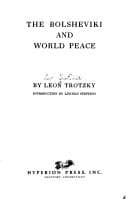
Communism -- Soviet Union; Europe -- Social conditions -- 20th century; Socialism; World War, 1914-1918
Third in order is the factor of diplomacy. Diplomacy here has a two-fold
task to perform. First, it must bring about war at the moment most
favorable for its own country from the international as well as the
military standpoint. Second, it must employ methods which throw the
burden of responsibility for the bloody conflict, in public opinion, on
the enemy government. The exposure of diplomatic trickery, cheating and
knavery is one of the most important functions of Socialist political
agitation. But no matter to what extent we succeed in this at the
crucial juncture, it is clear that the net of diplomatic intrigues in
themselves signifies nothing either as regards the historic rôle of the
war or its real initiators. Bismarck’s clever manoeuvres forced Napoleon
III to declare war on Prussia, although the actual initiative came from
the German side.
Next follows the purely military aspect. The _strategic_ plan of
operations can be calculated chiefly for defense or attack, regardless
of which side declared the war and under what conditions. Finally, the
first tactics followed in the carrying out of the strategic plan not
infrequently plays a great part in estimating the war as a war of
defense or of aggression.
"It is a good thing," wrote Engels to Marx on July 31, 1870,
"that the French attacked first on German soil. If the Germans
repel the invasion and follow it up by invading French
territory, then it will certainly not produce the same
impression as if the Germans had marched into France without a
previous invasion. In this way the war remains, on the French
side, more Bonapartistic."
Thus we see by the classic example of the Franco-Prussian War that the
standards for judging whether a war is defensive or aggressive are full
of contradictions when two nations clash. Then how much more so are
they when it is a clash of several nations. If we unroll the tangle
from the beginning, we arrive at the following connection between the
elements of attack and defense. The first _tactical_ move of the French
should--at least in Engels’ opinion--make the people feel that the
responsibility of attack rested with the French. And yet the entire
_strategic_ plan of the Germans had an absolutely aggressive character.
The _diplomatic_ moves of Bismarck forced Bonaparte to declare war
against his will and thus appear as the disturber of the peace of
Europe, while the military-political initiative in the war came from the
Prussian government. These circumstances are by no means of slight
importance for the _historical_ estimate of the war, but they are not at
all exhaustive.
One of the causes of this war was the growing ambition of the Germans
for national self-determination, which conflicted with the dynastic
pretensions of the French Monarchy. But this national "war of defense"
led to the annexation of Alsace-Lorraine and so in its second stage
turned into a dynastic war of conquest.
Public-domain text, read in full here on John Shaqi.
Reviews
Reviews
No reviews yet
Be the first to share your thoughts on this work.
Join the Discussion
Join the discussion
Sign in to leave a comment or review.
Sign InorCreate an account