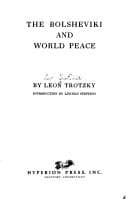
Communism -- Soviet Union; Europe -- Social conditions -- 20th century; Socialism; World War, 1914-1918
The correspondence between Marx and Engels shows that they were guided
chiefly by historical considerations in their attitude towards the War
of 1870. To them, of course, it was by no means a matter of
indifference as to who conducted the war and how it was conducted. "Who
would have thought it possible," Marx writes bitterly, "that twenty-two
years after 1848 a nationalist war in Germany could have been given such
theoretical expression." Yet what was of decisive significance to Marx
and Engels was the objective consequences of the war. "If the Prussians
triumph, it will mean the centralization of the state power--useful to
the centralization of the German working-class."
Liebknecht and Bebel, starting with the same historical estimate of the
war, were directly forced to take a political position toward it. It
was by no means in opposition to the views of Marx and Engels, but, on
the contrary, with their perfect acquiescence that Liebknecht and Bebel
refused, in the Reichstag, to take any responsibility for this War. The
statement they handed in read:
"We cannot grant the war appropriations that the Reichstag is
asked to make because that would be a vote of confidence in the
Prussian government.... As opponents on principle of every
dynastic war, as Social Republicians and members of the
International Labor Association, which, without distinction of
nationality, fights all oppressors and endeavors to unite all
the oppressed in one great brotherhood, we cannot declare
ourselves either directly or indirectly in favor of the present
war."
Schweitzer acted differently. He took the historical estimate of the
war as a direct guide for his tactics--one of the most dangerous of
fallacies!--and in voting the war credits gave a vote of confidence to
the policy of Bismarck. And this in spite of the fact that it was
necessary, if the centralization of state power arising out of the War
was to turn out of use to the Social Democratic cause, that the
working-class should from the very beginning oppose the dynastic-Junker
centralization with their own class-centralization filled with
revolutionary distrust of the rulers.
Schweitzer’s political attitude invalidated the very consequences of the
War that had induced him to give a vote of confidence to the makers of
the War.
Forty years later, drawing up the balance sheet of his life-work, Bebel
wrote:
Public-domain text, read in full here on John Shaqi.
Reviews
Reviews
No reviews yet
Be the first to share your thoughts on this work.
Join the Discussion
Join the discussion
Sign in to leave a comment or review.
Sign InorCreate an account