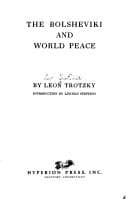
Communism -- Soviet Union; Europe -- Social conditions -- 20th century; Socialism; World War, 1914-1918
"It does not seem possible to me that under such circumstances a German
political party can preach _total obstruction_, and place all sorts of
minor considerations above the main issue." _Total obstruction!_--But
there is a wide gap between total obstruction and the total capitulation
of a political party. And it was this gap that divided the positions
between Bebel and Schweitzer in 1870. Marx and Engels were with Bebel
against Schweitzer. Comrade Kautsky might have informed his leader
writer, Hermann Wendel, of this fact. And it is nothing but defamation
of the dead for _Simplicissimus_ now to reconcile the shades of Bebel
and Bismarck in Heaven. If _Simplicissimus_ and Wendel have the right
to awaken anybody from his sleep in the grave for the endorsement of the
present tactics of the German Social Democracy, then it is not Bebel,
but Schweitzer. It is the shade of Schweitzer that now oppresses the
political party of the German proletariat.
But the very analogy between the Franco-Prussian War and the present War
is superficial and misleading in the extreme. Let us set aside all the
international relations. Let us forget that the War meant first of all
the destruction of Belgium, and that Germany’s main force was hurled not
against Czarism but republican France. Let us forget that the starting
point of the War was the crushing of Servia, and that one of its aims
was the strengthening and consolidation of the arch-reactionary state,
Austria-Hungary. We will not dwell on the fact that the attitude of the
German Social Democracy dealt a hard blow at the Russian Revolution,
which in the two years before the War had again flared up in such a
tempest. We will close our eyes to all these facts, just as the German
Social Democracy did on August 4th, when it did not see that there was a
Belgium in the world, a France, England, Servia, or Austria-Hungary. We
will grant only the existence of Germany.
In 1870 it was quite easy to estimate the historical significance of the
war. "If the Prussians win, the centralization of state power will
further the centralization of the German working class." And now? What
would be the result for the German working class of a Prussian victory
now?
The only territorial expansion which the German working class could
welcome, because it would complete the national unity, is a union of
German Austria with Germany. Any other expansion of the German
fatherland means another step towards the transformation of Germany from
a national state to a state of nationalities, and the consequent
introduction of all those conditions which render more difficult the
class struggle of the proletariat.
Public-domain text, read in full here on John Shaqi.
Reviews
Reviews
No reviews yet
Be the first to share your thoughts on this work.
Join the Discussion
Join the discussion
Sign in to leave a comment or review.
Sign InorCreate an account