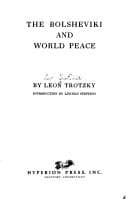
Communism -- Soviet Union; Europe -- Social conditions -- 20th century; Socialism; World War, 1914-1918
Ludwig Frank hoped--and he expressed this hope in the language of a
belated Lassallian--that later, after a victorious war, he would devote
himself to the work of the "internal building up" of the state. There
is no doubt that Germany will need this "internal building up" after a
victory no less than before the War. But will a victory make this work
easier? There is nothing in Germany’s historical experiences any more
than in those of any other country to justify such a hope.
"We regarded the doings of the rulers of Germany [after the
victories of 1870] as a matter of course," says Bebel in his
_Autobiography_. "It was merely an illusion of the Party
Executive to believe that a more liberal spirit would prevail in
the new order. And this more liberal régime was to be granted by
the same man who had till then shown himself the greatest enemy,
I will not say of democratic development, but even of every
liberal tendency, and who now as victor planted the heel of his
Cuirassier boot on the neck of the new Empire." (Vol. II, p.
188.)
There is absolutely no reason to expect different results now from a
victory from above. On the contrary. In 1870 Prussian Junkerdom had
first to adapt itself to the new imperial order. It could not feel
secure in the saddle all at once. It was eight years after the victory
over France that the anti-Socialist laws were passed. In forty-four
years Prussian Junkerdom has become the imperial Junkerdom. And if,
after half a century of the most intense class struggle, Junkerdom
should appear at the head of the victorious nation, then we need not
doubt that it would not have felt the need of Ludwig Frank’s services
for the internal building up of the state had he returned safe from the
fields of German victories.
But far more important than the strengthening of the class position of
the rulers is the influence a German victory would have upon the
proletariat itself. The war grew out of imperialistic antagonisms
between the capitalist states, and the victory of Germany, as stated
above, can produce only one result--territorial acquisitions at the
expense of Belgium, France and Russia, commercial treaties forced upon
her enemies, and new colonies. The class struggle of the proletariat
would then be placed upon the basis of the imperialistic hegemony of
Germany, the working class would be interested in the maintenance and
development of this hegemony, and revolutionary Socialism would for a
long time be condemned to the rôle of a propagandist sect.
Marx was right when in 1870 he foresaw, as a result of the German
victories, a rapid development for the German labor movement under the
banner of scientific Socialism. But now the international conditions
point to the very opposite prognosis. Germany’s victory would mean the
taking of the edge off the revolutionary movement, its theoretic
shallowing, and the dying out of the Marxist ideas.
Public-domain text, read in full here on John Shaqi.
Reviews
Reviews
No reviews yet
Be the first to share your thoughts on this work.
Join the Discussion
Join the discussion
Sign in to leave a comment or review.
Sign InorCreate an account