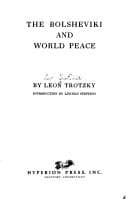
Communism -- Soviet Union; Europe -- Social conditions -- 20th century; Socialism; World War, 1914-1918
Also, however, Trotzky is a strong man who is ruled by and represents a
very simple-minded people who are acting like him, literally upon the
theory that the people govern now, in Russia; the common people; and
that, since they don’t like the War of the Czar, the Kaiser, the Kings
and the Emperors, their government should make peace with the peoples of
the world, a democratic peace against imperialism and capitalism and the
state everywhere, for the establishment in its stead of a free,
world-wide democracy.
That may be the true explanation of Trotzky’s Bolshevik peace policy in
the world crisis of the World War. That is the explanation which is
suggested by this book.
"Written in extreme haste," he says at the close of his preface, "under
conditions far from favorable to systematic work ... the entire book,
from the first page to the last, was written with the idea of the New
International constantly in mind--the New International which must rise
out of the present world cataclysm, the International of the last
conflict and the final victory."
LINCOLN STEFFENS.
New York, January 4th, 1918
AUTHOR’S PREFACE
The forces of production which capitalism has evolved have outgrown the
limits of nation and state. The national state, the present political
form, is too narrow for the exploitation of these productive forces.
The natural tendency of our economic system, therefore, is to seek to
break through the state boundaries. The whole globe, the land and the
sea, the surface as well as the interior, has become one economic
workshop, the different parts of which are inseparably connected with
each other. This work was accomplished by capitalism. But in
accomplishing it the capitalist states were led to struggle for the
subjection of the world-embracing economic system to the profit
interests of the bourgeoisie of each country. What the politics of
imperialism has demonstrated more than anything else is that the old
national state that was created in the revolutions and the wars of
1789-1815, 1848-1859, 1864-1866, and 1870 has outlived itself, and is
now an intolerable hindrance to economic development.
The present War is at bottom a revolt of the forces of production
against the political form of nation and state. It means the collapse
of the national state as an independent economic unit.
Public-domain text, read in full here on John Shaqi.
Reviews
Reviews
No reviews yet
Be the first to share your thoughts on this work.
Join the Discussion
Join the discussion
Sign in to leave a comment or review.
Sign InorCreate an account