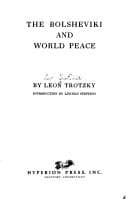
Communism -- Soviet Union; Europe -- Social conditions -- 20th century; Socialism; World War, 1914-1918
The methods of national-parliamentary opposition not only fail to
produce practical results, but also cease to make an appeal to the
laboring masses, because the workers find that, behind the backs of the
parliamentarians, imperialism, by armed force, reduces the wages and the
very lives of the workers to ever greater dependence on its successes in
the world market.
It was clear to every thinking Socialist that the only way the
proletariat could be made to pass from opportunism to Revolution was not
by agitation, but by a historical upheaval. But no one foresaw that
history would preface this inevitable change of tactics by such a
catastrophal collapse of the International. History works with titanic
relentlessness. What is the Rheims Cathedral to History? And what a
few hundred or thousand political reputations? And what the life or
death of hundreds of thousands or of millions?
The proletariat has remained too long in the preparatory school, much
longer than its great pioneer fighters thought it would. History took
her broom in hand, swept the International of the epigone apart in all
directions and led the slow-moving millions into the field where their
last illusions are being washed away in blood. A terrible experiment!
On its result perhaps hangs the fate of European civilization.
CHAPTER XI
THE REVOLUTIONARY EPOCH
At the close of the last century a heated controversy arose in Germany
over the question, What effect does the industrialization of a country
produce upon its military power? The reactionary agrarian politicians
and writers, like Sehring, Karl Ballod, Georg Hansen and others, argued
that the rapid increase of the city populations at the expense of the
rural districts positively undermined the foundation of the Empire’s
military power, and they of course drew from it their patriotic
inferences in the spirit of agrarian protectionism. On the other hand
Lujo Brentano and his school championed an exactly opposite point of
view. They pointed out that economic industrialism not only opened up
new financial and technical resources, but also developed in the
proletariat the vital force capable of making effective use of all the
new means of defense and attack. He quotes authoritative opinions to
show that even in the earlier experiences of 1870-71 "the regiments from
the preponderantly industrial district of Westphalia were among the very
best." And he explains this fact quite correctly by the far greater
ability of the industrial worker to find his bearings in new conditions
and to adjust himself to them. Now which side is right? The present War
proves that Germany, which has made the greatest progress along
capitalistic lines, was able to develop the highest military power. And
likewise in regard to all the countries drawn into it the War proves
what colossal and yet competent energy the working class develops in its
warlike activities.
Public-domain text, read in full here on John Shaqi.
Reviews
Reviews
No reviews yet
Be the first to share your thoughts on this work.
Elsewhere in the archive
Join the Discussion
Join the discussion
Sign in to leave a comment or review.
Sign InorCreate an account