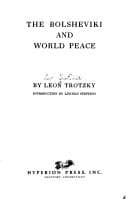
Communism -- Soviet Union; Europe -- Social conditions -- 20th century; Socialism; World War, 1914-1918
It is not the passive horde-like heroism of the
peasant masses, welded together by fatalistic submissiveness and
religious superstition. It is the individualized spirit of sacrifice,
born of inner impulse, ranging itself under the banner of the Idea.
But the Idea under whose banner the armed proletariat now stands, is the
Idea of war-crafty nationalism, the deadly enemy of the true interests
of the workers. The ruling class showed themselves strong enough to
force their Idea upon the proletariat, and the proletariat, in the
consciousness of what they were doing, put their intelligence, their
enthusiasm and their courage at the service of their class-foes. In this
fact is sealed the terrible defeat of Socialism. But it also opens up
all possibilities for a final victory of Socialism. There can be no
doubt that a class which is capable of displaying such steadfastness and
self-sacrifice in a war it considers a "just" one, will be still more
capable of developing these qualities when the march of events will give
it tasks really worthy of the historical mission of this class.
The epoch of the awakening, the enlightenment and the organization of
the working-class revealed that it has tremendous resources of
revolutionary energy which found no adequate employment in the daily
struggle. The Social Democracy summoned the upper strata of the
proletariat into the field, but it also checked their revolutionary
energy by adopting the tactics it was obliged to adopt, the tactics of
_waiting_, the strategy of letting your opponent exhaust himself. The
character of this period was so dull and reactionary that it did not
allow the Social Democracy the opportunity to give the proletariat tasks
that would have engaged their whole spirit of sacrifice.
Imperialism is now giving them such tasks. And imperialism attained its
object by pushing the proletariat into a position of "national defense,"
which, to the workers, meant the defense of all their hands had created,
not only the immense wealth of the nation, but also their own
class-organizations, their treasuries, their press, in short, everything
they had unwearyingly, painfully struggled for and attained in the
course of several decades. Imperialism violently threw society off its
balance, destroyed the sluice-gates built by the Social Democracy to
regulate the current of proletarian revolutionary energy, and guided
this current into its _own_ bed.
But this terrific historical experiment, which at one blow broke the
back of the Socialist International, carries a deadly danger for
bourgeois society itself. The hammer is wrenched out of the worker’s
hand and a gun put into his hand instead. And the worker, who has been
tied down by the machinery of the capitalist system, is suddenly torn
from his usual setting and taught to place the aims of society above
happiness at home and even life itself.
Public-domain text, read in full here on John Shaqi.
Reviews
Reviews
No reviews yet
Be the first to share your thoughts on this work.
Elsewhere in the archive
Join the Discussion
Join the discussion
Sign in to leave a comment or review.
Sign InorCreate an account