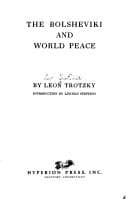
Communism -- Soviet Union; Europe -- Social conditions -- 20th century; Socialism; World War, 1914-1918
With the weapon in his hand that he himself has forged, the worker is
put in a position where the political destiny of the state is directly
dependent upon him. Those who exploited and scorned him in normal
times, flatter him now and toady to him. At the same time he comes into
intimate contact with the cannon, which Lassalle calls one of the most
important ingredients of all constitutions. He crosses the border,
takes part in forceful requisitions, and helps in the passing of cities
from one party to another. Changes are taking place such as the present
generation has never before seen.
Even though the vanguard of the working-class knew in theory that Might
is the mother of Right, still their political thinking was completely
permeated by the spirit of opportunism, of adaptation to bourgeois
legalism. Now they are learning from the teachings of facts to despise
this legalism and tear it down. Now dynamic forces are replacing the
static forces in their psychology. The great guns are hammering into
their heads the idea that if it is impossible to get around an obstacle,
it is possible to destroy it. Almost the entire adult male population
is going through this school of war, so terrible in its realism, a
school which is forming a new human type. Iron necessity is now shaking
its fist at all the rules of bourgeois society, at its laws, its
morality, its religion. "Necessity knows no law," said the German
Chancellor on August 4th. Monarchs walk about in public places calling
each other liars in the language of market-women; governments repudiate
their solemnly acknowledged obligations, and the national church ties
its God to the national cannon like a criminal condemned to hard labor.
Is it not clear that all these circumstances must bring about a profound
change in the mental attitude of the working-class, curing them
radically of the hypnosis of legality in which a period of political
stagnation expresses itself?
The possessing classes, to their consternation, will soon have to
recognize this change. A working-class that has been through the school
of war will feel the need of using the language of force as soon as the
first serious obstacle faces them within their own country. "Necessity
knows no law" the workers will cry when the attempt is made to hold them
back at the command of bourgeois law. And poverty, the terrible poverty
that prevails during this war and will continue after its close, will be
of a sort to force the masses to violate many a bourgeois law. The
general economic exhaustion in Europe will affect the proletariat most
immediately and most severely. The state’s material resources will be
depleted by the war, and the possibility of satisfying the demands of
the working-masses will be very limited. This must lead to profound
political conflicts, which, ever-widening and deepening, may take on the
character of a social revolution, the course and outcome of which no
one, of course, can now foresee.
Public-domain text, read in full here on John Shaqi.
Reviews
Reviews
No reviews yet
Be the first to share your thoughts on this work.
Elsewhere in the archive
Join the Discussion
Join the discussion
Sign in to leave a comment or review.
Sign InorCreate an account