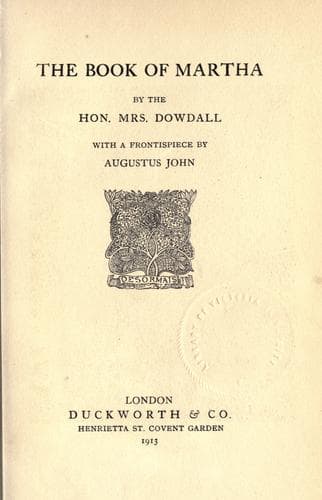
England -- Social life and customs -- Humor; English wit and humor; Housekeeping -- Humor; Marriage -- Humor
I was engaged to be married to a man with the usual professional
income, and I began to see very clearly that if I was to be happy in a
small house the number of people living in it must be reduced as much
as possible. That night when the servants were all in bed I took up my
letters again and explained this theory to James. He agreed with me.
We were married early in January, and went into our house a week
later. I had engaged two maids, both of whom had been recommended
to me as thoroughly capable, and likely to bring light into the dark
places of my inexperience. They did indeed; I saw all its weak points
very clearly in the lurid glare of their bright ideas. But that was
later. On our first day at home I went down to the kitchen as soon as
my husband had gone out. I picked my way through the cinders, crumbs,
bacon-rind, and unclassified fluff upon the floor, and stood for a
moment blistering before the range where a blast-furnace raged behind
the bars. The remains of breakfast, which suggested the snatched meal
of a burglar, prepared in haste and darkness, were on the table, from
which Clara, the housemaid, rose and made a slippery exit after the
manner of a mouse.
I murmured something polite about being too soon, to which the cook
replied that they were a bit late on account of the range, and the
curtain rose on a farce which will run as long as I keep a cook.
The bell at the back door then fell into the first of a long and
distressing series of convulsions, and Ruth went to its assistance.
“Pleas’m, the butcher,” she reported.
There are many ways of saying “Pleas’m, the butcher,” and Ruth’s
was most discouraging. I knew at a glance that she had not properly
masticated her breakfast, and that the arrival of the butcher was not
unlike that of twins at the end of a numerous and undesired family. She
looked as though her morning had been made up of a series of unwelcome
events and this were the last straw.
“Tell him to call again,” I said hastily; “this is an absurd time to
come.” I was going to retire when a second convulsion shook the house
to its foundations.
“Do you wish fish’m?” said Ruth, just as if I had sent the fish. I
hedged and tried to shift the blame on her.
“Do we want fish?”
“Just as you wish’m,” she said, standing still in front of me.
She made no attempt to suggest anything.
“I’ll come,” said I, “and see him myself.”
I found a pert-looking male child writing his name on the pantry
window-sill and whistling.
“What fish have you got?” I asked.
“Plaiceakecoddensole,” he replied, eyeing me up and down.
I ordered something--anything to convey the idea that I spoke with
knowledge and deliberation. The greengrocer behaved like an uncle, and
told me that, whatever else I went without, a nice cauliflower was a
thing I should never regret buying. I expected him to add that it would
last a lifetime and clean again as good as new.
Public-domain text, read in full here on John Shaqi.
Reviews
Reviews
No reviews yet
Be the first to share your thoughts on this work.
Join the Discussion
Join the discussion
Sign in to leave a comment or review.
Sign InorCreate an account