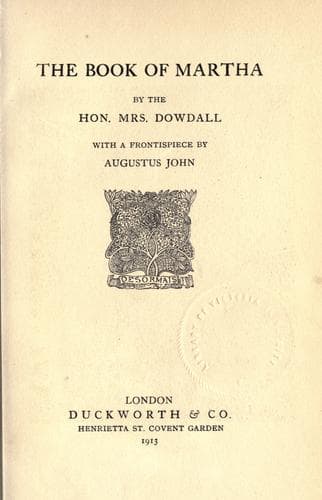
England -- Social life and customs -- Humor; English wit and humor; Housekeeping -- Humor; Marriage -- Humor
Miss Mathers was full of pleasant surprises. I found that she
enjoyed music-halls, approved of divorce (which she called a capital
arrangement if two people could not agree), and disliked the idea of
Women’s Suffrage. I pointed out that she was inconsistent in approving
of divorce notwithstanding her religious principles, and she explained
her reasons over some hot buttered toast before retiring to bed.
“My brother divorced his wife,” she said, “for reasons which are
warranted by Scripture, and I hold him to be in the right. It was
far better than if he had compelled her to live with him under false
pretences of affection.”
“But if she ran away,” I suggested.
“In that case,” said Miss Mathers, “she would have continued to bear
his name, and would therefore have been living in open sin. My
brother, by taking the course he did, gave her the opportunity to
retrieve her character by becoming respectably married. The Church is
perfectly right in refusing to sanction divorce, because persons who
place themselves in such a position ought to be outside the pale of
religion, but I think the law acts wisely in providing for legitimate
separation.”
On another buttered toast night I asked her why she disliked Women’s
Suffrage. If I had had any knowledge of character I might have guessed
her reason, but Miss Mathers was not like anyone I had met before.
“My dear Mrs. Molyneux,” she said, “the poet Byron has most truly
observed that
‘_Man’s love is of his life a thing apart;
’Tis woman’s whole existence._’
It is true that it does not fall to the lot of all of us to love in
that sense, but the possibility can never be lost sight of. What
could you conceive more ludicrous and unsuitable than that the whole
existence of one of our rulers should be merged in passionate feelings
for a fellow-creature? Public life demands whole-hearted devotion to
the State.”
“But great statesmen often fall dreadfully in love,” I said.
“A thing apart, Mrs. Molyneux, believe me,” the romantic creature
said with assurance. “When my brother’s nose is in his books or his
inkpot or wherever else it may happen to be, it is _there_; temporarily
perhaps, but he gives his whole mind to it. When he emerges he may
be the slave of any woman, only not at the time. But I assure you I
have seen women attempt to transact the business of an office, when
they were in love, with deplorable results. I do not say they are
incapable of renouncing their private passions for the sake of what
they apprehend to be their duty, but I maintain that their services to
that duty will not be worth a pin so long as the renouncement is in
progress. And the public service cannot wait while they recover.”
“A great many people will disagree with you, Miss Mathers,” I said.
“A great many people have not loved,” she replied. “I speak from
observation only.”
Public-domain text, read in full here on John Shaqi.
Reviews
Reviews
No reviews yet
Be the first to share your thoughts on this work.
Join the Discussion
Join the discussion
Sign in to leave a comment or review.
Sign InorCreate an account