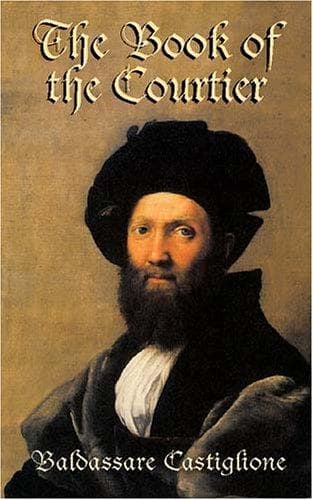
The Book of the CourtierCastiglione, Baldassarre, conte
History
The Book of the Courtier
Castiglione, Baldassarre, conte
Courtesy -- Early works to 1800; Courts and courtiers -- Early works to 1800
From Alinari’s photograph (no. 7351) of the portrait, in the Colonna
Gallery at Rome, variously attributed to Raphael’s father, Giovanni
Santi (1440?-1494), and (by Morelli) to Melozzo degli Ambrosi da
Forli (1438-1494). Schmarzow’s iconographical identification of this
portrait (formerly supposed to represent Raphael as a boy) is
confirmed by its close resemblance to the young duke’s features as
shown on coins issued in the early years of his reign.
2.—On the slopes of the Apennines towards the Adriatic sea, almost in
the centre of Italy, there lies (as everyone knows) the little city of
Urbino. Although amid mountains, and less pleasing ones than perhaps
some others that we see in many places, it has yet enjoyed such favour
of heaven that the country round about is very fertile and rich in
crops; so that besides the wholesomeness of the air, there is great
abundance of everything needful for human life. But among the greatest
blessings that can be attributed to it, this I believe to be the chief,
that for a long time it has ever been ruled by the best of lords;[24]
although in the calamities of the universal wars of Italy, it was for a
season deprived of them.[25] But without seeking further, we can give
good proof of this by the glorious memory of Duke Federico,[26] who in
his day was the light of Italy; nor is there lack of credible and
abundant witnesses, who are still living, to his prudence, humanity,
justice, liberality, unconquered courage,—and to his military
discipline, which is conspicuously attested by his numerous victories,
his capture of impregnable places, the sudden swiftness of his
expeditions, the frequency with which he put to flight large and
formidable armies by means of a very small force, and by his loss of no
single battle whatever;[27] so that we may not unreasonably compare him
to many famous men of old.
Among his other praiseworthy deeds, he built on the rugged site of
Urbino a palace regarded by many as the most beautiful to be found in
all Italy; and he so well furnished it with everything suitable that it
seemed not a palace but a city in the form of a palace; and not merely
with what is ordinarily used,—such as silver vases, hangings of richest
cloth-of-gold and silk, and other similar things,—but for ornament he
added countless antique statues in marble and bronze, pictures most
choice, and musical instruments of every sort, nor would he admit
anything there that was not very rare and excellent. Then at very great
cost he collected a goodly number of most excellent and rare books in
Greek, Latin and Hebrew, all of which he adorned with gold and with
silver, esteeming this to be the chiefest excellence of his great
palace.[28]
Public-domain text, read in full here on John Shaqi.
Reviews
Reviews
No reviews yet
Be the first to share your thoughts on this work.
Join the Discussion
Join the discussion
Sign in to leave a comment or review.
Sign InorCreate an account