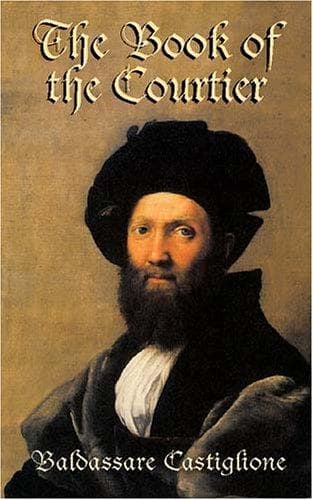
The Book of the CourtierCastiglione, Baldassarre, conte
History
The Book of the Courtier
Castiglione, Baldassarre, conte
Courtesy -- Early works to 1800; Courts and courtiers -- Early works to 1800
15.—Then my lord Gaspar said:
“I would not have us enter upon such subtleties, because these ladies
will not understand us, and although I answer you with excellent
arguments, they will believe (or at least pretend to believe) that I am
wrong, and straightway will pronounce judgment to their liking. Yet
since we are already begun, I will say merely this, that (as you know is
the opinion of very wise men) man resembles form, and woman matter; and
therefore, just as form is more perfect than matter,—nay, gives it its
being,—so man is far more perfect than woman. And I remember having once
heard that a great philosopher says in some of his problems:[342] ‘Why
is it that a woman always naturally loves the man who first tasted the
sweets of love with her? and on the contrary a man holds that woman in
hatred who was the first to give herself to him?’ And adding the reason,
he affirms it to be this: because in this matter the woman receives
perfection from the man, and the man imperfection from the woman; and
therefore everyone naturally loves that thing which makes him perfect,
and hates that which makes him imperfect. And besides this, a great
argument for the perfection of man and for the imperfection of woman is
that every woman universally desires to be a man, by a certain natural
instinct that teaches her to desire her perfection.”
16.—The Magnifico Giuliano at once replied:
“The poor creatures do not desire to be men in order to be perfect, but
in order to have liberty and to escape that dominion over them which man
has arrogated to himself by his own authority. And the analogy that you
cite of matter and form does not apply in everything; for woman is not
made perfect by man, as matter by form: because matter receives its
being from form and cannot exist without it; nay, the more matter forms
have, the more they have of imperfection, and are most perfect when
separated from it. But woman does not receive her being from man; nay,
just as she is made perfect by him, she also makes him perfect. Hence
both join in procreation, which neither of them can effect without the
other.
“Therefore I will assign the cause of woman’s lasting love for the first
man to whom she has given herself, and of man’s hatred for the first
woman, not at all to that which your Philosopher alleges in his
problems, but to woman’s firmness and constancy, and to man’s
inconstancy; nor without natural reason: for being warm, the male
naturally derives from that quality lightness, movement and inconstancy,
while from her frigidity woman on the other hand derives quietness, firm
gravity, and more fixed impressions.”
17.—Then my lady Emilia turned to my lord Magnifico and said:
Public-domain text, read in full here on John Shaqi.
Reviews
Reviews
No reviews yet
Be the first to share your thoughts on this work.
Elsewhere in the archive
Join the Discussion
Join the discussion
Sign in to leave a comment or review.
Sign InorCreate an account