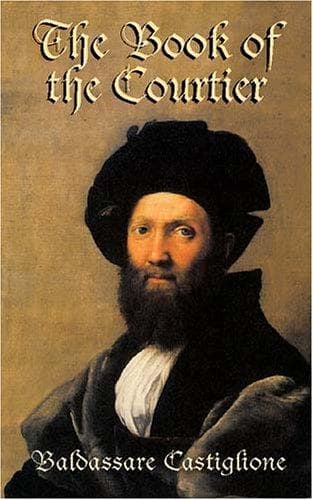
The Book of the CourtierCastiglione, Baldassarre, conte
History
The Book of the Courtier
Castiglione, Baldassarre, conte
Courtesy -- Early works to 1800; Courts and courtiers -- Early works to 1800
“For the love of Heaven, leave these matters and forms of yours awhile,
and male and female, and speak in such fashion that you may be
understood; for we heard and understood very well the evil that my lord
Ottaviano and my lord Gaspar said of us, but now we do not at all
understand in what manner you are defending us: so it seems to me that
you are straying from the subject and leaving in everyone’s mind that
bad impression which these enemies of ours have given of us.”
“Do not give us that name, my Lady,” replied my lord Gaspar, “for it
better befits my lord Magnifico, who by bestowing false praises upon
women shows that there are none true of them.”
The Magnifico Giuliano continued:
“Do not doubt, my Lady, that answer will be made to everything. But I do
not wish to utter such inordinate abuse of men as they have uttered of
women; and if by chance there were anyone to write down our discussions,
I should not like, in a place where these matters and forms are
understood, to have the arguments and reasons that my lord Gaspar
adduces against you, appear to have been without reply.”
“I do not see, my lord Magnifico,” my lord Gaspar then said, “how in
this matter you will be able to deny that man is by his natural
qualities more perfect than woman, who is frigid by temperament, and man
warm. And warmth is far nobler and more perfect than cold, because it is
active and productive; and, as you know, the heavens send down only
warmth upon us here, and not cold, which does not enter into the works
of nature. And hence I believe that the frigidity of women’s temperament
is the cause of their abasement and timidity.”
18.—“So you too,” replied the Magnifico Giuliano, “wish to enter into
subtleties; but you shall see that you will always have the worst of it:
and that this is true, listen.
“I grant you that warmth is in itself more perfect than cold; but this
is not the case with things mixed and composite; for if it were so, that
body which is warmer would be more perfect, which is false, because
temperate bodies are most perfect. Moreover, I tell you that woman is of
frigid temperament by comparison with man, who by excess of warmth is
far from temperate; but as for her, she is temperate (or at least more
nearly temperate than man is) because she has in her a moisture
proportioned to her natural warmth, which in man usually evaporates by
reason of excessive dryness and is consumed. Furthermore, her coldness
is of the kind that resists and moderates her natural warmth and makes
it more nearly temperate; while in man the surplus warmth soon raises
his natural heat to the highest pitch, which wastes away for lack of
sustenance. And thus, as men lose more in procreation than women do, it
often happens that they are less long lived than women; wherefore this
perfection also may be ascribed to women, that, living longer than men,
they perform better than men that which is the intent of nature.
Public-domain text, read in full here on John Shaqi.
Reviews
Reviews
No reviews yet
Be the first to share your thoughts on this work.
Elsewhere in the archive
Join the Discussion
Join the discussion
Sign in to leave a comment or review.
Sign InorCreate an account