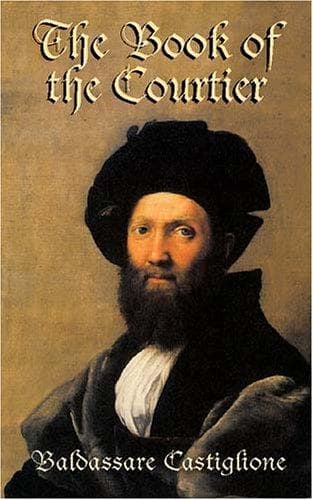
The Book of the CourtierCastiglione, Baldassarre, conte
History
The Book of the Courtier
Castiglione, Baldassarre, conte
Courtesy -- Early works to 1800; Courts and courtiers -- Early works to 1800
Page
LIST OF PLATES xi
INTERLOCUTORS xiv
THE AUTHOR’S DEDICATORY LETTER 1
Reasons for writing the book, and for at first delaying and
afterwards hastening its publication. Lament at the recent
death of several persons mentioned in the book. Answer to three
objections: that the book was not written in the language of
Boccaccio; that, as it is impossible to find a perfect
Courtier, it was superfluous to describe one; and that the
author presumed to paint his own portrait.
THE FIRST BOOK OF THE COURTIER 7
1: The book written at the instance of Alfonso Ariosto and in
dialogue form, in order to record certain discussions held at
the court of Urbino. 2-3: Description and praise of Urbino and
its lords; Duke Federico and his son Guidobaldo. 4-5: The
Urbino court and the persons taking part in the discussions. 6:
Circumstances that led to the discussions; visit of Pope Julius
II. 7-11: Various games proposed. 12: Game finally chosen: to
describe a perfect Courtier. 13-6: Canossa begins the
discussion by enumerating some of the conditions essential to
the Courtier,—especially gentle birth. 17-8: Arms the true
profession of the Courtier, who must, however, avoid arrogance
and boasting. 19-22: Physical qualities and martial exercises.
23: Short bantering digression. 24-6: Grace. 27-8: Affectation.
29-39: Literary and conversational style. 40: Women’s
affectations. 41: Moral qualities. 42-6: Literary
accomplishments; arms vs. letters. 47-8: Music. 49: Painting.
50-3: Painting vs. sculpture. 54-6: Arrival of the youthful
Francesco Maria della Rovere; the evening’s entertainment ends
with dancing.
THE SECOND BOOK OF THE COURTIER 75
1-4: Reasons why the aged are wont to laud the past and to
decry the present; defence of the present against such
aspersions; praise of the court of Urbino. 5-6 Federico Fregoso
begins the discussion on the way and time of employing the
qualities and accomplishments described by Canossa: utility of
such discussion. 7-8: General rules: to avoid affectation, to
speak and act discreetly and opportunely, to aim at honour and
praise in martial exercises, war, and public contests, 9-10:
Other physical exercises. 11: Dancing and masquerading. 12-3:
Music of various kinds, when to be practised. 14: Aged
Courtiers not to engage publicly in music and dancing. 15-6:
Duty of aged and youthful Courtiers to moderate the faults
peculiar to their years. 17-25: Conversation, especially with
superiors; how to win favours worthily. 26-8: Dress and
ornament; lamentable lack of fashions peculiarly Italian.
29-30: Choice and treatment of friends. 31: Games of cards and
chess.
Public-domain text, read in full here on John Shaqi.
Reviews
Reviews
No reviews yet
Be the first to share your thoughts on this work.
Join the Discussion
Join the discussion
Sign in to leave a comment or review.
Sign InorCreate an account