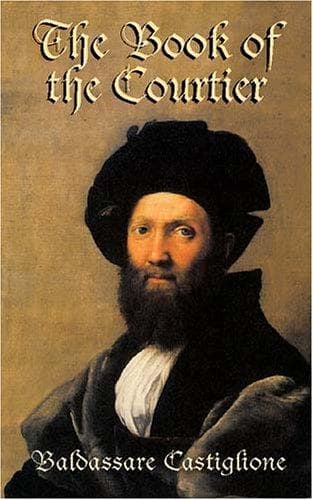
The Book of the CourtierCastiglione, Baldassarre, conte
History
The Book of the Courtier
Castiglione, Baldassarre, conte
Courtesy -- Early works to 1800; Courts and courtiers -- Early works to 1800
“In that statues are more enduring, perhaps we might say they are of
greater dignity; for being made as memorials, they fulfil better than
painting the purpose for which they are made. But besides serving as
memorials, both painting and sculpture serve also to beautify, and in
this respect painting is much superior; for if less diuturnal (so to
speak) than sculpture, yet it is of very long life, and is far more
charming so long as it endures.”
Then Giancristoforo replied:
“I really think that you are speaking against your convictions and that
you are doing so solely for the sake of your friend Raphael; and perhaps
too the excellence you find in his painting seems to you so consummate
that sculpture cannot rival it: but consider that this is praise of an
artist and not of his art.”
[Illustration:
MICHELANGELO BUONARROTI
1475-1564
]
Reduced from a photograph, specially made by Soame, of an anonymous and
hitherto unpublished bronze head at Oxford. From a death-mask,
Michelangelo’s pupil Daniele Ricciarelli da Volterra (1500-1566)
prepared a mould, of which this and the similar “Piot” head in the
Louvre are believed to be unchased castings. See C. Drury E.
Fortnum’s article “On the Bronze Portrait Busts of Michelangelo,”
etc., in the Archæological Journal.
Then he continued:
“It seems clear to me that both the one and the other are artificial
imitations of nature; but I do not see how you can say that truth, such
as nature makes it, is not better imitated in a marble or bronze
statue,—wherein the members are round, formed and measured, as nature
makes them,—than in a painting, where we see nothing but the surface and
those colours that cheat the eyes; nor will you tell me, surely, that
being is not nearer truth than seeming. Moreover I think sculpture is
more difficult, because if a slip is made, it cannot be corrected (since
marble cannot be patched again), but another statue must be made anew;
which does not happen with painting, for one may change a thousand
times, and add and take away, improving always.”
51.—The Count said, laughing:
“I am not speaking for Raphael’s sake; nor ought you to repute me so
ignorant as not to know the excellence of Michelangelo in sculpture,
your own, and others’. But I am speaking of the art, and not of the
artists.
Public-domain text, read in full here on John Shaqi.
Reviews
Reviews
No reviews yet
Be the first to share your thoughts on this work.
Elsewhere in the archive
Join the Discussion
Join the discussion
Sign in to leave a comment or review.
Sign InorCreate an account