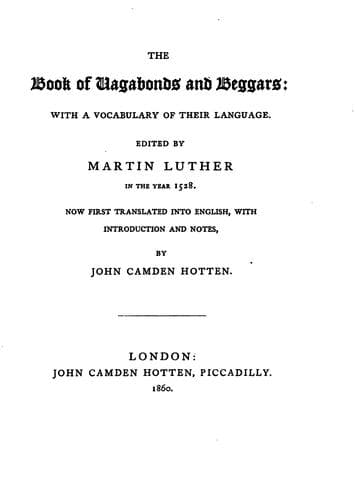
The Book of Vagabonds and Beggars, with a Vocabulary of Their Language
History
The Book of Vagabonds and Beggars, with a Vocabulary of Their Language
Begging -- Germany; German language -- Slang; Wayfaring life -- Germany
Travelling quack-doctors, against whom Luther cautions his readers,
were common in this country up to the beginning of the present
century.[10] And it is not long ago since the credulous countrymen in
our rural districts, were cheated by fellows—“wise-men” they preferred
being termed—who pretended to divine dreams, and say under which tree
or wall the hidden treasure, so plainly seen by Hodge in his sleep
carefully deposited in a crock, was to be found. This pleasant idea
of a pot full of gold, being buried near everybody, seems to have
possessed people in all ages. In Luther’s time the nobility and clergy
appear to have been sadly troubled with it, and it is very amusing to
learn that so simple in this respect were the latter, that after they
had given “gold and silver” to the cunning treasure-seeker, this worthy
would insist upon their offering up masses in order that the digging
might be attended with success!
And lastly, the travelling tinkers,—who appear to have had no better
name for honesty in the fifteenth century than they have now,—“going
about breaking holes in people’s kettles to give work to a multitude of
others,” says the little book.
With regard to the Rothwelsch Sprache, or cant language used by these
vagrants, it appears, like nearly all similar systems of speech, to be
founded on allegory. Many of the terms, as in the case of the ancient
cant of this country, appear to be compound corruptions,—two or more
words, in ordinary use, twisted and pronounced in such a way as to
hide their original meaning. As Luther states, in his preface, the
Hebrew appears to be a principal element. Occasionally a term from a
neighbouring country, or from a dead language may be observed, but
not frequently. As they occur in the original I have retained those
cant words which are to be found here and there in the text. Perhaps
it would have rendered a perusal less tedious had they been placed
as foot-notes; but I preferred to adhere to the form in which Luther
was content the little book should go forth to the world. The simple
form of these secret terms has generally been given, there being no
established rule for their inflection. In a few instances I found
myself unable to give English equivalents to the cant words in the
Vocabulary, so was compelled to leave them unexplained, but with the
old German meanings (not easy to be unravelled) attached.
JOHN CAMDEN HOTTEN.
_Piccadilly, June, 1860._
[Illustration]
+Liber Vagatorum+
THE BOOK OF VAGABONDS AND
BEGGARS WITH A PREFACE
BY MARTIN
LUTHER
[Illustration]
_Printed at_ WITTEMBERG _in the year_
M.D.XXIX.
_MARTIN LUTHER’S PREFACE._
_This little book about the knaveries of beggars was first printed by
one who called himself_ Expertus in Truffis, _that is, a fellow right
expert in roguery,—which the little work very well proves, even though
he had not given himself such a name._
Public-domain text, read in full here on John Shaqi.
Reviews
Reviews
No reviews yet
Be the first to share your thoughts on this work.
Join the Discussion
Join the discussion
Sign in to leave a comment or review.
Sign InorCreate an account