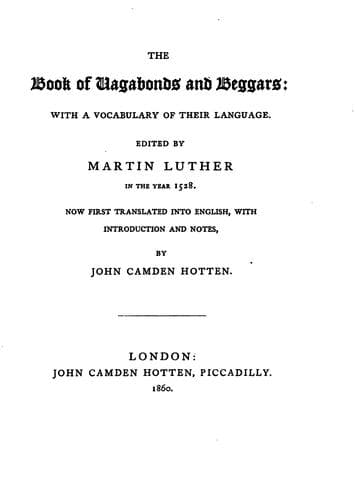
The Book of Vagabonds and Beggars, with a Vocabulary of Their Language
History
The Book of Vagabonds and Beggars, with a Vocabulary of Their Language
Begging -- Germany; German language -- Slang; Wayfaring life -- Germany
The WILTNERS, or finders of pretended silver fingers, noticed at page
45, are now-a-days represented by the “Fawney Riggers,” or droppers
of counterfeit gold rings,—described in _Mayhew’s London Labour_, and
other works treating of the ways of vagabonds.
“Card-Sharpers,” or JONERS, mentioned at page 47, are, unfortunately
for the pockets of the simple, still to be met with on public
race-courses and at fairs.
The OVER-SÖNZEN-GOERS, or pretended distressed gentry, who went about
“neatly dressed,” with false letters, would seem to have been the
original of our modern “Begging-Letter-Writers.”
Those half-famished looking impostors, with clean aprons, or carefully
brushed threadbare coats, who stand on the curbs of our public
thoroughfares, and beg with a few sticks of sealing-wax in their
hands, were known in Luther’s time as GOOSE-SHEARERS. As the reader
will have experienced only too frequently, they have, when pretending
to be mechanics out of employ, a particularly unpleasant practice of
following people, and detailing, in half-despairing, half-threatening
sentences, the state of their pockets and their appetites. It appears
they did the same thing more than three centuries ago.
Another class, known amongst London street-folk as
“Shivering-Jemmies,”—fellows who expose themselves, half-naked, on a
cold day, to excite pity and procure alms—were known in Luther’s time
as SCHWANFELDERS,—only in those days, people being not quite
so modest as now, they stripped themselves entirely naked before
commencing to shiver at the church-doors.
Those wretches, who are occasionally brought before the police
magistrates, accused of maiming children, on purpose that they may the
better excite pity and obtain money, are, unfortunately, not peculiar
to our civilized age. These fellows committed like cruelties centuries
ago.
Borrowers of children, too,—those pretended fathers of numerous and
starving families of urchins, now often heard howling in the streets
on a wet day, the children being arranged right and left according to
height,—existed in the olden time,—only then the loan was but for All
Souls’, or other Feast Day, when the people were in a good humour.
The trick of placing soap in the mouth to produce froth, and falling
down before passers-by as though in a fit, common enough in London
streets a few years ago, is also described as one of the old manœuvres
of beggars.[9]
Public-domain text, read in full here on John Shaqi.
Reviews
Reviews
No reviews yet
Be the first to share your thoughts on this work.
Join the Discussion
Join the discussion
Sign in to leave a comment or review.
Sign InorCreate an account