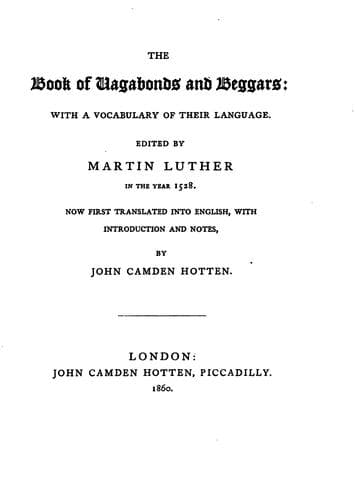
The Book of Vagabonds and Beggars, with a Vocabulary of Their Language
History
The Book of Vagabonds and Beggars, with a Vocabulary of Their Language
Begging -- Germany; German language -- Slang; Wayfaring life -- Germany
_BREGEN_, to beg. Both this and the following are probably
corruptions of the _German_, PREDIGEN, to pray, to preach; or they
may have come from the _Old German_, BRACHER, a pauper. Possibly,
however, they are nothing more than corruptions of BEGHARD, the
name given to a low order of friars before the Reformation. These
professed poverty, and lived on alms. Their orthodoxy and morality
were doubtful. In general they were denounced by the ecclesiastical
authorities. _See_ Mosheim, _de_ BEGHARDIS _et Beguinis_. The term
evidently comes from the _Saxon_, BEGGEN, mendicare; and HARD, or
HART, a servant.
_BREGER_, a beggar.
_BREITHART_, far, wide,—BREIT here being equivalent to broad, or
wide; and HART, to very, or exceedingly.
_BREITFUSS_, a goose, or duck,—literally, a “broad-foot.”
_BRESEM_, BRÜCH, to break. The _Old German_, BRUCH, signifies
_fractura_, _ruptura_; _femoralia_; _locus palustris_; _infractio
legis_. The _Modern German_, BRUCH, refers to a breach or rupture
in a person, especially a breakage caused by violence.
_BRIEF_, a playing card. _German_, BRIEF, a letter.
_BRIEFELVETZER_, a clerk. _Vide_ FETZEN.
_BRIEFEN_, to play at cards.
_BRISSEN_, to denounce.
_BRÜSS_, a leper.
_BSAFFOT_, a letter, a cipher. The _German_, ZIFFER, signifies a
cipher, and probably comes from the _Arabic_ or _Hebrew_,—SÉPHER in
the latter being equivalent to writing, a writing, or whatever is
written in a book.
_BSCHIDERICH_, a magistrate. Probably this term, together with
the following, were merely vulgar adaptations of the _German_,
BESCHEIDEN, to appoint, to be discreet. The _Old German_,
BESCHEID-RIK, might be translated as “powerful in decision,” and
BESCHEIDRUOM, “renowned for discretion or modesty.”
_BSCHUDERULM_, nobility.
_BÜTZELMAN_, ZAGEL. The _German_, ZAGEL, is a provincial word, and
signifies a tail. _See_ SCHEISS.
_DALLINGER_, a hangman. Probably a corruption of GALGENER,—from the
_German_, GALGEN, a gallows, or gibbet.
_DERLING_, a die (plural _dice_).
_DIERLING_, the eye. Possibly a diminutive of the _German_, THÜR, a
door, or entrance,—not inappropriately applied to the eye, as the
little door out of which all things are seen.
_DIERN_, to see.
_DIFTEL_, a church. Probably a corruption of the _German_,
STIFTEL,—a diminutive of STIFT, a cathedral. STIFTUNG is a
foundation, establishment; STIFTER, a founder.
_DIPPEN_, to give. _German_, GEBEN.
_DOLMAN_, the gallows. The _German_, DOLMAN, properly signifies a
pelisse,—the tight-fitting nature of which may have given rise to
the cant application to a gallows.
_DOTSCH_, _vulva_. Supposed by some to be from the _German_,
TASCHE, a pocket. The _Bavarian_ words DOTSCH, DOST, DOSTEN,
however, still signify _vulva_.
Public-domain text, read in full here on John Shaqi.
Reviews
Reviews
No reviews yet
Be the first to share your thoughts on this work.
Join the Discussion
Join the discussion
Sign in to leave a comment or review.
Sign InorCreate an account