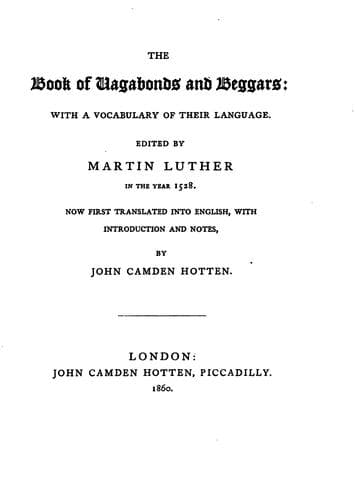
The Book of Vagabonds and Beggars, with a Vocabulary of Their Language
History
The Book of Vagabonds and Beggars, with a Vocabulary of Their Language
Begging -- Germany; German language -- Slang; Wayfaring life -- Germany
_DOUL_ (_i. e._ DÖEL,—DAUL), a penny. The fourth part of a
BLECHLEIN, or kreuzer.
_DRITLING_, a shoe. From the _Old German_, TRITLING, a footstool, a
bench,—a diminutive of TRITT, _gradus_, _passus incessus_, _cursus
pedestris_. TRETTEN is _omnes pedum motus_, from the _Celtic_,
TRUD; _Ancient British_, TROED,—so that it seems very probable that
TRITLING, or DRITLING, may have meant a little treader, or shoe.
_DÜ EIN HAR_, FLEUCH.
_EMS_, good. The _German_, EMSIG, is assiduous; DIE EMSIGE BIENE,
the busy bee. It seems to come from the _Old German_, EMMAZZIG, for
UNMUAZIG, _occupatus et minime otiosus_. After the same fashion is
derived the _French_, A-MUSER.
_ERFERKEN_ (ERSECKEN?), RETSCHEN.
_ERLAT_, the master. The _Welch_, HERLOD, is a stripling, lad;
HERLODES, a damsel, girl. It is supposed that the word “harlot,”
which originally signified a bold stripling, is from this. Chaucer
says:—
A sturdie _harlot_—that was her hostes man,
He was a gentil _harlot_, and a kind.
If ERLAT is from the _German_, it would be from HERRLAUT, a
distinguished lord, a master.
_ERLATIN_, the mistress.
_FELING_, a grocery, or general store; a grocer’s wife.
_FETZEN_, or VETZEN, to work, to make. _Latin_, FACERE. The
_German_, FETZEN, signifies a piece, or slice.
_FLADER_, a bath-room, a barber’s shop.
_FLADER-FETZER_, a barber.
_FLADER-FETZERIN_, a barber’s wife.
_FLICK_, KNAB. _Hilpert_ refers to FLÜGGE, unfledged.
_FLOSS_, soup. From the _German_, _FLOSS_, a stream; FLOSSEN, to
flow.
_FLOSSART_, water.
_FLÖSSELT_, drowned. Previous to the time of Luther, beggars were
drowned when caught stealing. _Vide_ Gengenbach.
_FLÖSSLEN_, to make water.
_FLÖSSLING_, a fish. _German_, FLOSSE, a fin.
_FLUCKART_, poultry, birds. From the _German_, FLIEGEN, to fly;
literally, “fly-hard,” or “fast-flyer.”
_FUNKART_, fire. _German_, FUNKE, a spark.
_FUNKARTHOLE_, an earthenware stove.
_FÜNKELN_, to boil, cook, roast.
_GACKENSCHERR_, a chicken. _German_, GACKERN, to cackle; SCHARREN,
to scratch.
_GALCH_, a parson, priest. The _Old German_, GALL, is _castratus_;
the same with GELDE,—whence GOL, GEL, sterile. The _German_,
KELCH, is a chalice, the communion cup. GALCH may be, however,
simply an extension of GALLE.
_GALCHENBOSS_, a parsonage.
_GALLE_, a parson. _Hebrew_, KÁHAL, a priest.
_GALLEN_, a town.
_GANHART_, the devil.
_GATZAM_, a child. _Hebrew_, GATAM, said to be derived from an
_Arabic_ word, signifying any one puny or thin. Or from the
_German_, KÄTZCHEN, a little cat, a kitten.
_GEBICKEN_, to catch.
_GENFEN_, or JENFEN, to steal.
_GFAR_, a village. _Hebrew_, CHÁFÁR, a village, hamlet.
_GIEL_, the mouth.
_GITZLIN_, a morsel of bread.
_GLATHART_, a table. _German_, GLATT, smooth.
_GLENZ_, a field.
Public-domain text, read in full here on John Shaqi.
Reviews
Reviews
No reviews yet
Be the first to share your thoughts on this work.
Join the Discussion
Join the discussion
Sign in to leave a comment or review.
Sign InorCreate an account