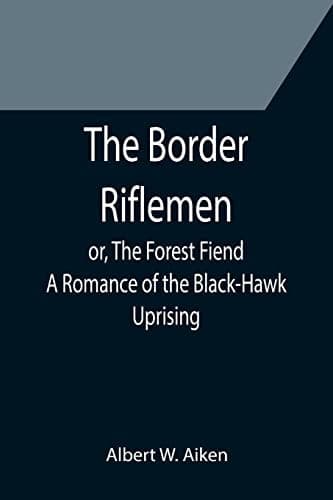
The Border Riflemen; or, The Forest Fiend. A Romance of the Black-Hawk Uprising — John Shaqi
The Border Riflemen; or, The Forest Fiend. A Romance of the Black-Hawk UprisingAiken, Albert W.
General
The Border Riflemen; or, The Forest Fiend. A Romance of the Black-Hawk Uprising
Aiken, Albert W.
Black Hawk War, 1832 -- Fiction; Dime novels
Napope and Na-she-eschuck dragged him away, and Black-Hawk uttered a
signal whoop which quickly brought four stalwart Indians to the spot,
who, at the command of Black-Hawk, fastened up the keg, and making a
sort of cradle of strong boughs, carried the liquor away toward the
sacred forest, being solemnly warned not to touch it on their lives.
After them marched the remaining chiefs and Black-Hawk, taking a
sequestered path through the wood. Half an hour’s walk brought them to a
deep glen in the midst of the solemn woods, where a sort of rude altar
was erected, and where the mystic ceremonies of their strange religion
were nearly always observed. A solitary tree of small size, with a
blackened trunk, the scene of many a sacrifice, was standing in the
center of the glade, and there, tightly bound with green withes, stood
Little Fox awaiting his fate.
The Indian was sober enough now, for nothing brings a man to his senses
so quickly, no matter how much stupefied by drink, as the presence of
danger. His eyes roved from face to face for some sign of relenting or
pity, but he found none.
“Why has Black-Hawk brought a Pottawattomie here?” he said. “He dare not
shed the blood of the son of Na-bo-lish.”
“Na-bo-lish was a great chief but his son is a dog,” he said.
“Black-Hawk will not shed his blood, and a coward’s death he shall die.”
“Little Fox knows how to die, if die he must,” replied the Indian,
proudly. “He will speak no more and he dares Black-Hawk to do his
worst.”
The summons had gone forth, and one by one the chiefs and warriors began
to enter the sacred wood. Every face was clouded, for they knew that
they would not have been called to this place but to witness some great
sacrifice. A single glance at the prisoner was all they gave, and then,
man by man, they seated themselves in a great circle and waited for the
coming of others. In less than an hour from the time when Little Fox was
taken, five hundred grim warriors were seated within the glade, and then
Black-Hawk arose.
“Chiefs and warriors,” he cried—“children of the same great Father,
although our tribes are many—listen to Black-Hawk. He is getting old,
his hair is gray, but he weeps for the sorrows of the poor Indian. Once,
all these great hunting-grounds, in which the white man plants his corn,
were the property of the Indian. There he lived—there he died, and there
he lies buried. The steel of the white man’s plow is among the bones,
and he builds his lodge in the villages which once were ours.
Public-domain text, read in full here on John Shaqi.
Reviews
Reviews
No reviews yet
Be the first to share your thoughts on this work.
Join the Discussion
Join the discussion
Sign in to leave a comment or review.
Sign InorCreate an account