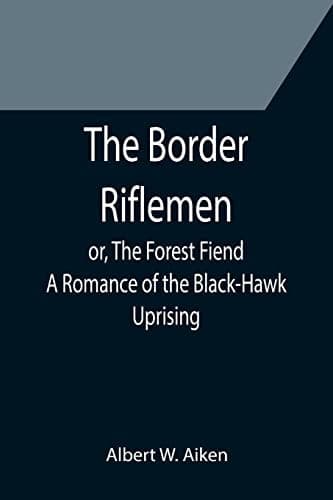
The Border Riflemen; or, The Forest Fiend. A Romance of the Black-Hawk Uprising — John Shaqi
The Border Riflemen; or, The Forest Fiend. A Romance of the Black-Hawk UprisingAiken, Albert W.
General
The Border Riflemen; or, The Forest Fiend. A Romance of the Black-Hawk Uprising
Aiken, Albert W.
Black Hawk War, 1832 -- Fiction; Dime novels
“This should make an Indian very sad, and he should do all he can to
help his people. But there are some who are so base that for the
fire-water of the white man they would sell their fathers’ bones. It
grieves the heart of Black-Hawk that this should be so, for he loves the
Indian. Now, when we have risen for our rights, and to protect our once
happy homes, Indians of the pure blood stand ready to give us up a prey
to the white man, that they may drink the strong water which makes men
mad.
“Look upon this man. He is a son of the great Na-bo-lish, the
Pottawattomie. Once, he was a man and a mighty warrior. His foot was
quick upon the war-path, and his hand ready to shed the blood of his
enemies. The white men came and brought the strong water to the
villages. Little Fox was no longer a man when he had taken it into his
mouth. Let Na-she-eschuck speak, and tell the warriors what Little Fox
has done, and then let them speak. I have done.”
He sat down amid a strange murmuring, and Na-she-eschuck arose. The
young chief was well known for his strict honesty, and they were assured
that he would not lie to save his life.
“My father has spoken good words. Little Fox has sold us to the white
men for a rifle, two blankets and this fire-water,” striking the keg
with his foot. “Out of his own mouth condemn him. Let him die.”
Napope arose.
“I heard the words which came from the lips of Little Fox, and the Sac
has spoken the truth. Let Little Fox die like a dog.”
“And I heard it,” cried the Prophet. “I—Wa-be-ke-zhick, the Prophet. He
sold us to the white men and he deserves to die. Now let the chiefs and
warriors speak.”
There was a sudden movement among the listening warriors. They arose as
one man, and every voice pealed out the solemn sentence: “He is a
traitor; let him die!”
“You are women,” shrieked the Pottawottamie, fiercely. “Do your worst;
Little Fox will show you how to die.”
“It is well,” said Black-Hawk, slightly inclining his head. “We will not
deny that Little Fox has been a great brave, but he is now a dog. Let
the chiefs come about me, and we will have a talk.”
They were not long in consultation, and then separated, the chiefs going
about among the men and giving their orders. Then a long-sounding whoop
from Black-Hawk called them into line, and they began to circle about
the tree, pointing their fingers scornfully at the prisoner. Then
Black-Hawk advanced and bared the breast of the prisoner, exposing the
totem of his tribe.
“Look,” he said, “he bears upon his bosom the sign of a great tribe.
This is not well, and it must be removed. Wa-be-ke-zhick, advance, and
cut the totem from his flesh.”
“Cut away the totem of the great tribe,” cried the warriors. “He has no
right to wear it, who is a dog. Cut it away!”
The countenance of Little Fox was distorted with rage more than fear.
Drunken and worthless as he had become, he was a true Indian, and felt
keenly the disgrace about to be put upon him.
Public-domain text, read in full here on John Shaqi.
Reviews
Reviews
No reviews yet
Be the first to share your thoughts on this work.
Join the Discussion
Join the discussion
Sign in to leave a comment or review.
Sign InorCreate an account