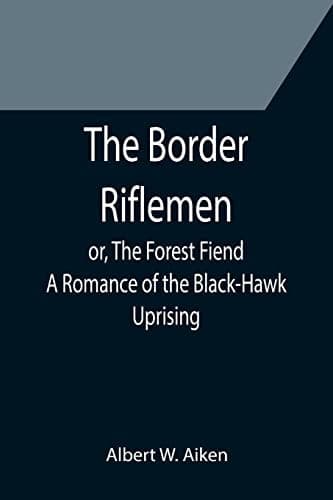
The Border Riflemen; or, The Forest Fiend. A Romance of the Black-Hawk Uprising — John Shaqi
The Border Riflemen; or, The Forest Fiend. A Romance of the Black-Hawk UprisingAiken, Albert W.
General
The Border Riflemen; or, The Forest Fiend. A Romance of the Black-Hawk Uprising
Aiken, Albert W.
Black Hawk War, 1832 -- Fiction; Dime novels
The trail was quickly found, and led to the northward. They followed it
swiftly, Cooney Joe bending slightly in the saddle, and keeping his eyes
on the trail, while the rest followed, keeping far enough behind not to
disturb the trail. After a march of nearly two miles, the track suddenly
ended upon the bank of the Father of Waters, and they knew that the
scoundrels had taken to the stream.
“Now ain’t this cussid mean; ain’t it enuff to make a man raise his hand
against his venerable ancestor?” roared Joe. “They’ve took water, they
hev. Here; send back two men with the hosses, fur we’ve got to hoof it.”
This plan was adopted, and two of the men returned with the horses,
while the rest searched about among the reeds, and after some trouble
found two rude dug-outs concealed, in which, by making two trips, they
crossed the great stream. Here they scattered and searched up and down
for the trail which they had lost, still guided by the ponderous hoof of
Dick Garrett.
“Oh, _ain’t_ he pizen, that Dick!” growled Cooney Joe. “Its just his
nat’ral cussedness, you know. He’s aweer that I like to ride, and he
jest done this to be mean. Comes nat’ral to him, meanness does. Here you
are; come on, boys!”
He had taken up the recovered trail as if no interruption had occurred,
and the party moved on across the plain. They were tried men, who had
followed Captain Melton in many an hour of danger, but even their hearts
gave a great leap as they plunged into the Indian country, perhaps never
to return.
CHAPTER VII.
OVERBOARD.
The surprise of the occupants of the log-cabin by the river was sudden
and complete, when at a late hour the house was surrounded by a motley
group headed by a man who, in spite of his paint and feathers, could not
hide from so acute a scout as Samuel Wescott that he was a white man in
disguise. The rush was so sudden that they had been overthrown before
they had fairly time to reach their weapons, and the captured men were
at once hurried to their horses, and the band made off at a rapid rate
up the stream. Mr. Wescott was wounded, but in spite of that the savage
white leader urged him on, threatening him with the point of his knife
if he faltered or turned aside. They reached the river, when, to the
surprise of all, a flat-boat shot out from the western bank and made
toward the eastern shore. The men who held the poles were either white
men or showed a marvelous aptitude for flat-boating, an accomplishment
rarely to be looked for in an Indian who is not in love with manual
labor. The bow of the flat grated on the low beach, when the party went
on board, horses and all, and they pushed out into the stream.
“This boat belonged to Captain Hughes’ father,” whispered Sadie. “Is it
possible that these wretches have murdered him and his crew?”
Public-domain text, read in full here on John Shaqi.
Reviews
Reviews
No reviews yet
Be the first to share your thoughts on this work.
Join the Discussion
Join the discussion
Sign in to leave a comment or review.
Sign InorCreate an account