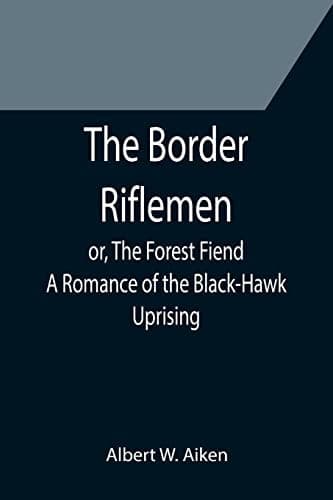
The Border Riflemen; or, The Forest Fiend. A Romance of the Black-Hawk UprisingAiken, Albert W.
General
The Border Riflemen; or, The Forest Fiend. A Romance of the Black-Hawk Uprising
Aiken, Albert W.
Black Hawk War, 1832 -- Fiction; Dime novels
“He ought to have come down some days ago,” said Mr. Wescott, in an
uneasy tone. “I am afraid that the good old man has indeed fallen. Be
careful what you say, for these scoundrels understand every word you
speak.”
At this moment the chief approached and caught Mr. Wescott by his
wounded arm, causing him to utter a low cry of pain, while the blood
gushed from under his hand.
“No whispering,” he hissed, dropping all at once his assumed Indian
habits. “I’m no baby, Sam Wescott, but a bird of the woods, a
Mississippi roarer, and I can lick the universal earth a-flying.”
“Dick Garrett!” cried Wescott, in a tone of surprise. “I thought so.”
“You know me, do ye?” said Dick, with an air of bravado. “All right,
’square, it’s all the wuss for you, for Dick Garrett don’t let no man
live that knows he wears an Injin rig. Git ropes hyar and take a couple
of hitches on this chap, some of you fellers.”
“What do you intend to do?” cried Wescott, struggling. “Hands off, you
scoundrels!”
“Tie him tight, boys,” replied Dick Garrett, in fiendish glee. “Teach
the cuss to be so sharp, I will, before I git done with him. Now, then,
Sam Wescott, if you’ve got any prayers to say, say ’em quick, for
overboard you go when we get to that snag in the river.”
“You cannot mean it,” said Wescott. “Such a cold blooded and unprovoked
murder—”
“Oh, give us a rest or I’ll gag you,” replied Dick Garrett. “The matter
of a man more or less in the world ain’t going to shake it to its
center, you bet, and when I say you’ve got to go under, then you go.”
“Have your way, then, murderous wretch,” cried the brave man, drawing
himself up proudly. “I will not beg for my life from such as you, and am
ready to die, if my time has come, as bravely as another. Do your
worst.”
Sadie by this time began to comprehend the danger in which her father
stood, and would have come to him, but she was forced back by one of the
rough men who wore the Indian garb, but who could not conceal a certain
flat-boat swagger which betrayed him.
“He crows loud, boys, don’t he?” said Garrett; “mighty loud for a bird
of his feather that’s only got three minnits to live. Keep the gal away;
she ain’t got leave to die yet.”
“Let me go to my father,” pleaded Sadie. “Oh, sir, you will not kill him
for a single hasty word?”
“I rather think I shall,” replied Garrett, as cool and composed as if
talking of any ordinary event. “The man’s got to go. I don’t advertise
to be a saint, and when a man runs ag’inst me and calls me a murderer, I
reckon it’s about time for him to pass in his chips. I’m a peaceable
man—I will _have_ peace, or a fight.”
This strange man was dreadfully in earnest. Human life was to him a
thing of no price—we might lose it to-day or to-morrow, of we might live
a hundred years—a small matter, not to be taken into account. He had no
objections to killing a man, and if he had stood in his way, in any
manner, it became a _duty_ to put him aside.
Public-domain text, read in full here on John Shaqi.
Reviews
Reviews
No reviews yet
Be the first to share your thoughts on this work.
Join the Discussion
Join the discussion
Sign in to leave a comment or review.
Sign InorCreate an account