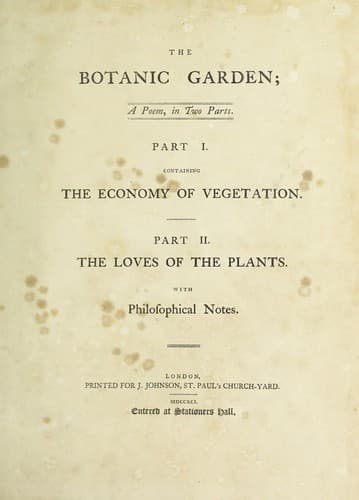
The Botanic Garden. Part 2, Containing the Loves of the Plants. A Poem.: With Philosophical Notes.Darwin, Erasmus
History
The Botanic Garden. Part 2, Containing the Loves of the Plants. A Poem.: With Philosophical Notes.
Darwin, Erasmus
Natural history; Plants -- Poetry
[_Lychnis._ l. 108. Ten males and five females. The flowers which
contain the five females, and those which contain the ten males, are
found on different plants; and often at a great distance from each other.
Five of the ten males arrive at their maturity some days before the other
five, as may be seen by opening the corol before it naturally expands
itself. When the females arrive at their maturity, they rise above the
petals, as if looking abroad for their distant husbands; the scarlet ones
contribute much to the beauty of our meadows in May and June.]
Proud GLORIOSA led _three_ chosen swains,
120 The blushing captives of her virgin chains.--
--When Time's rude hand a bark of wrinkles spread
Round her weak limbs, and silver'd o'er her head,
_Three_ other youths her riper years engage,
The flatter'd victims of her wily age.
125 So, in her wane of beauty, NINON won
With fatal smiles her gay unconscious son.--
[_Gloriosa_. l. 119. Superba. Six males, one female. The petals of this
beautiful flower with three of the stamens, which are first mature, stand
up in apparent disorder; and the pistil bends at nearly a right angle
to insert its stigma amongst them. In a few days, as these decline,
the other three stamens bend over, and approach the pistil. In the
Fritillaria Persica, the six stamens are of equal lengths, and the
anthers lie at a distance from the pistil, and three alternate ones
approach first; and, when these decline, the other three approach: in the
Lithrum Salicaria, (which has twelve males and one female) a beautiful
red flower, which grows on the banks of rivers, six of the males arrive
at maturity, and surround the female some time before the other six; when
these decline, the other six rise up, and supply their places. Several
other flowers have in similar manner two sets of stamens of different
ages, as Adoxa, Lychnis, Saxifraga. See Genista. Perhaps a difference
in the time of their maturity obtains in all these flowers, which have
numerous stamens. In the Kahnia the ten stamens lie round the pistil like
the radii of a wheel; and each anther is concealed in a nich of the corol
to protect it from cold and moisture; these anthers rise separately from
their niches, and approach the pistil for a time, and then recede to
their former situations.]
[Illustration: Gloriosa Superba]
Public-domain text, read in full here on John Shaqi.
Reviews
Reviews
No reviews yet
Be the first to share your thoughts on this work.
Join the Discussion
Join the discussion
Sign in to leave a comment or review.
Sign InorCreate an account