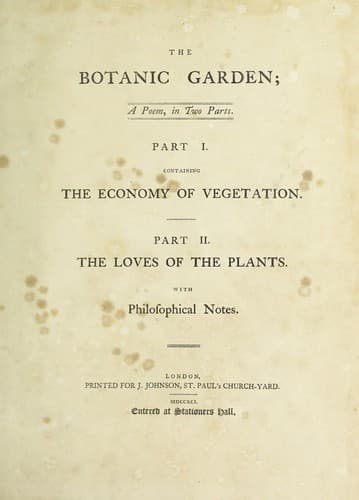
The Botanic Garden. Part 2, Containing the Loves of the Plants. A Poem.: With Philosophical Notes. — John Shaqi
The Botanic Garden. Part 2, Containing the Loves of the Plants. A Poem.: With Philosophical Notes.Darwin, Erasmus
History
The Botanic Garden. Part 2, Containing the Loves of the Plants. A Poem.: With Philosophical Notes.
Darwin, Erasmus
Natural history; Plants -- Poetry
Clasp'd in his arms she own'd a mother's name,--
"Desist, rash youth! restrain your impious flame,
"First on that bed your infant-form was press'd,
130 "Born by my throes, and nurtured at my breast."--
Back as from death he sprung, with wild amaze
Fierce on the fair he fix'd his ardent gaze;
Dropp'd on one knee, his frantic arms outspread,
And stole a guilty glance toward the bed;
135 Then breath'd from quivering lips a whisper'd vow,
And bent on heaven his pale repentant brow;
"Thus, thus!" he cried, and plung'd the furious dart,
And life and love gush'd mingled from his heart.
The fell SILENE and her sisters fair,
140 Skill'd in destruction, spread the viscous snare.
[_Silene_. l. 139. Catchfly. Three females and ten males inhabit each
flower; the viscous material, which surrounds the stalks under the
flowers of this plant, and of the Cucubulus Otites, is a curious
contrivance to prevent various insects from plundering the honey, or
devouring the seed. In the Dionaea Muscipula there is a still more
wonderful contrivance to prevent the depredations of insects: The leaves
are armed with long teeth, like the antennæ of insects, and lie spread
upon the ground round the stem; and are so irritable, that when an
insect creeps upon them, they fold up, and crush or pierce it to death.
The last professor Linneus, in his Supplementum Plantarum, gives the
following account of the Arum Muscivorum. The flower has the smell of
carrion; by which the flies are invited to lay their eggs in the chamber
of the flower, but in vain endeavour to escape, being prevented by the
hairs pointing inwards; and thus perish in the flower, whence its name
of fly-eater. P. 411. in the Dypsacus is another contrivance for this
purpose, a bason of water is placed round each joint of the stem. In
the Drosera is another kind of fly-trap. See Dypsacus and Drosera;
the flowers of Siléne and Cucúbalus are closed all day, but are open
and give an agreeable odour in the night. See Cerea. See additional
notes at the end of the poem.]
[Illustration: Dionna Muscipula]
[Illustration: Amaryllis formosissima]
The harlot-band _ten_ lofty bravoes screen,
And frowning guard the magic nets unseen.--
Haste, glittering nations, tenants of the air,
Oh, steer from hence your viewless course afar!
145 If with soft words, sweet blushes, nods, and smiles,
The _three_ dread Syrens lure you to their toils,
Limed by their art in vain you point your stings,
In vain the efforts of your whirring wings!--
Go, seek your gilded mates and infant hives,
150 Nor taste the honey purchas'd with your lives!
When heaven's high vault condensing clouds deform,
Fair AMARYLLIS flies the incumbent storm,
Public-domain text, read in full here on John Shaqi.
Reviews
Reviews
No reviews yet
Be the first to share your thoughts on this work.
Join the Discussion
Join the discussion
Sign in to leave a comment or review.
Sign InorCreate an account