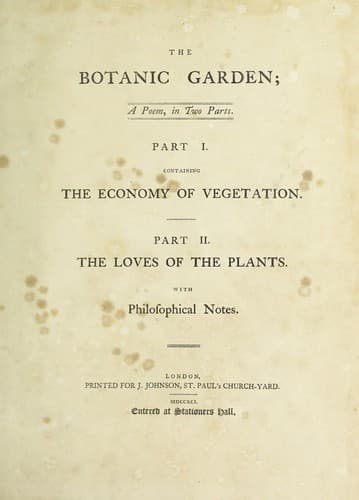
The Botanic Garden. Part 2, Containing the Loves of the Plants. A Poem.: With Philosophical Notes.Darwin, Erasmus
History
The Botanic Garden. Part 2, Containing the Loves of the Plants. A Poem.: With Philosophical Notes.
Darwin, Erasmus
Natural history; Plants -- Poetry
The Classes are distinguished from each other in this ingenious system,
by the number, situation, adhesion, or reciprocal proportion of the males
in each flower. The Orders, in many of these Classes, are distinguished
by the number, or other circumstances of the females. The Families, or
Genera, are characterized by the analogy of all the parts of the flower
or fructification. The Species are distinguished by the foliage of the
plant; and the Varieties by any accidental circumstance of colour, taste,
or odour; the seeds of these do not always produce plants similar to the
parent; as in our numerous fruit-trees and garden flowers; which are
propagated by grafts or layers.
The first eleven Classes include the plants, in whose flowers both the
sexes reside; and in which the Males or Stamens are neither united, nor
unequal in height when at maturity; and are therefore distinguished from
each other simply by the number of males in each flower, as is seen in
the annexed PLATE, copied from the Dictionaire Botanique of M. BULLIARD,
in which the numbers of each division refer to the Botanic Classes.
CLASS I. ONE MALE, _Monandria_; includes the plants which possess but One
Stamen in each flower.
II. TWO MALES, _Diandria_. Two Stamens.
III. THREE MALES, _Triandria_. Three Stamens.
IV. FOUR MALES, _Tetrandria_. Four Stamens.
V. FIVE MALES, _Pentandria_. Five Stamens.
VI. SIX MALES, _Hexandria_. Six Stamens.
VII. SEVEN MALES, _Heptandria_. Seven Stamens.
VIII. EIGHT MALES, _Octandria_. Eight Stamens.
IX. NINE MALES, _Enneandria_. Nine Stamens.
X. TEN MALES, _Decandria_. Ten Stamens.
XI. TWELVE MALES, _Dodecandria_. Twelve Stamens.
The next two Classes are distinguished not only by the number of equal
and disunited males, as in the above eleven Classes, but require an
additional circumstance to be attended to, _viz._ whether the males or
stamens be situated on the calyx, or not.
XII. TWENTY MALES, _Icosandria_. Twenty Stamens inserted on the calyx or
flower-cup; as is well seen in the last Figure of No. xii. in the annexed
Plate.
XIII. MANY MALES, _Polyandria_. From 20 to 100 Stamens, which do not
adhere to the calyx; as is well seen in the first Figure of No. xiii. in
the annexed Plate.
In the next two Classes, not only the number of stamens are to be
observed, but the reciprocal proportions in respect to height.
XIV. TWO POWERS, _Didynamia_. Four Stamens, of which two are lower than
the other two; as is seen in the two first Figures of No. xiv.
XV. FOUR POWERS, _Tetradynamia_. Six Stamens; of which four are taller,
and the two lower ones opposite to each other; as is seen in the third
Figure of the upper row in No. 15.
The five subsequent Classes are distinguished not by the number of the
males, or stamens, but by their union or adhesion, either by their
anthers, or filaments, or to the female or pistil.
Public-domain text, read in full here on John Shaqi.
Reviews
Reviews
No reviews yet
Be the first to share your thoughts on this work.
Join the Discussion
Join the discussion
Sign in to leave a comment or review.
Sign InorCreate an account