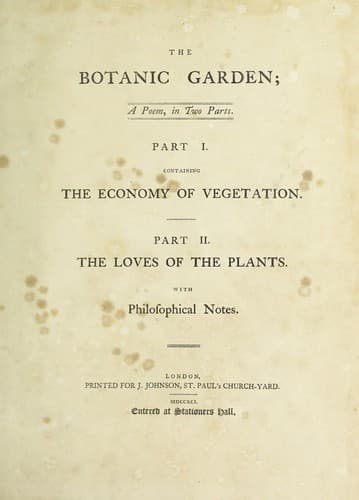
The Botanic Garden. Part 2, Containing the Loves of the Plants. A Poem.: With Philosophical Notes.Darwin, Erasmus
History
The Botanic Garden. Part 2, Containing the Loves of the Plants. A Poem.: With Philosophical Notes.
Darwin, Erasmus
Natural history; Plants -- Poetry
XVI. ONE BROTHERHOOD, _Monadelphia_. Many Stamens united by their
filaments into one company; as in the second Figure below of No. xvi.
XVII. TWO BROTHERHOODS, _Diadelphia_. Many Stamens united by their
filaments into two Companies; as in the uppermost Fig. No. xvii.
XVIII. MANY BROTHERHOODS, _Polyadelphia_. Many Stamens united by their
filaments into three or more companies, as in No. xviii.
XIX. CONFEDERATE MALES, _Syngenesia_. Many Stamens united by their
anthers; as in first and second Figures, No. xix.
XX. FEMININE MALES, _Gynandria_. Many Stamens attached to the pistil.
The next three Classes consist of plants, whose flowers contain but one
of the sexes; or if some of them contain both sexes, there are other
flowers accompanying them of but one sex.
XXI. ONE HOUSE, _Monoecia_. Male flowers and female flowers separate, but
on the same plant.
XXII. TWO HOUSES, _Dioecia_. Male flowers and female flowers separate, on
different plants.
XXIII. POLYGAMY, _Polygamia_. Male and female flowers on one or more
plants, which have at the same time flowers of both sexes.
The last Class contains the plants whose flowers are not discernible.
XXIV. CLANDESTINE MARRIAGE, _Cryptogamia_.
The Orders of the first thirteen Classes are founded on the number
of Females, or Pistils, and distinguished by the names, ONE FEMALE,
_Monogynia_. TWO FEMALES, _Digynia_. THREE FEMALES, _Trigynia_, &c. as is
seen in No. i. which represents a plant of one male, one female; and in
the first Figure of No. xi. which represents a flower with twelve males,
and three females; (for, where the pistils have no apparent styles, the
summits, or stigmas, are to be numbered) and in the first Figure of No.
xii. which represents a flower with twenty males and many females; and in
the last Figure of the same No. which has twenty males and one female;
and in No. xiii. which represents a flower with many males and many
females.
The Class of TWO POWERS, is divided into two natural Orders; into such
as have their seeds naked at the bottom of the calyx, or flower cup; and
such as have their seeds covered; as is seen in No. xiv. Fig. 3. and 5.
The Class of FOUR POWERS, is divided also into two Orders; in one of
these the seeds are inclosed in a silicule, as in _Shepherd's purse_.
No. xiv. Fig. 5. In the other they are inclosed in a silique, as in
_Wall-flower_. Fig. 4.
In all the other Classes, excepting the Classes Confederate Males, and
Clandestine Marriage, as the character of each Class is distinguished by
the situations of the males; the character of the Orders is marked by the
numbers of them. In the Class ONE BROTHERHOOD, No. xvi. Fig. 3. the Order
of ten males is represented. And in the Class TWO BROTHERHOODS, No. xvii.
Fig. 2. the Order ten males is represented.
In the Class CONFEDERATE MALES, the Orders are chiefly distinguished by
the fertility or barrenness of the florets of the disk, or ray of the
compound flower.
Public-domain text, read in full here on John Shaqi.
Reviews
Reviews
No reviews yet
Be the first to share your thoughts on this work.
Join the Discussion
Join the discussion
Sign in to leave a comment or review.
Sign InorCreate an account