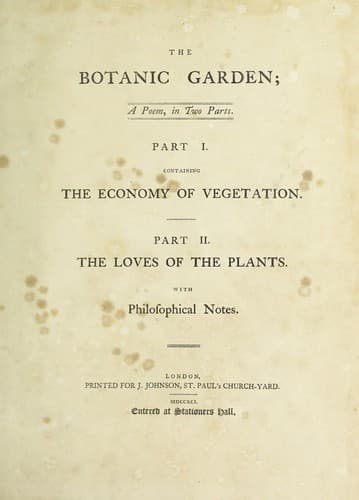
The Botanic Garden. Part 2, Containing the Loves of the Plants. A Poem.: With Philosophical Notes.Darwin, Erasmus
History
The Botanic Garden. Part 2, Containing the Loves of the Plants. A Poem.: With Philosophical Notes.
Darwin, Erasmus
Natural history; Plants -- Poetry
[_Drosera_. l. 231. Sun-dew. Five males, five females. The leaves
of this marsh-plant are purple, and have a fringe very unlike other
vegetable productions. And, which is curious, at the point of every
thread of this erect fringe stands a pellucid drop of mucilage,
resembling a ducal coronet. This mucus is a secretion from certain
glands, and like the viscous material round the flower-stalks of Silene
(catchfly) prevents small insects from infesting the leaves. As the
ear-wax in animals seems to be in part designed to prevent fleas and
other insects from getting into their ears. See Silene. Mr. Wheatly, an
eminent surgeon in Cateaton-street, London, observed these leaves to bend
upwards, when an insect settled on them, like the leaves of the muscipula
veneris, and pointing all their globules of mucus to the centre, that
they compleatly intangled and destroyed it. M. Broussonet, in the Mem. de
l'Acad. des Sciences for the year 1784. p. 615. after hiving described
the motion of the Dionæa, adds, that a similar appearance has been
observed in the leaves of two species of Drosera.]
Fair LONICERA prints the dewy lawn,
And decks with brighter blush the vermil dawn;
245 Winds round the shadowy rocks, and pansied vales,
And scents with sweeter breath the summer-gales;
[_Lonicera_. l. 243. Caprifolium. Honeysuckle. Five males, one female.
Nature has in many flowers used a wonderful apparatus to guard the
nectary, or honey-gland, from insects. In the honey-suckle the petal
terminates in a long tube like a cornucopiae, or horn of plenty; and
the honey is produced at the bottom of it. In Aconitum, monkshood, the
nectaries stand upright like two horns covered with a hood, which abounds
with such acrid matter that no insects penetrate it. In Helleborus,
hellebore, the many nectaries are placed in a circle, like little
pitchers, and add much to the beauty of the flower. In the Columbine,
Aquilegia, the nectary is imagined to be like the neck and body of a
bird, and the two petals standing upon each side to represent wings;
whence its name of columbine, as if resembling a nest of young pigeons
fluttering whilst their parent feeds them. The importance of the nectary
in the economy of vegetation is explained at large in the notes on part
the first.
Public-domain text, read in full here on John Shaqi.
Reviews
Reviews
No reviews yet
Be the first to share your thoughts on this work.
Join the Discussion
Join the discussion
Sign in to leave a comment or review.
Sign InorCreate an account