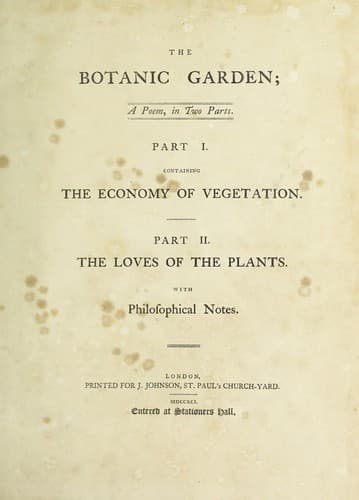
The Botanic Garden. Part 2, Containing the Loves of the Plants. A Poem.: With Philosophical Notes.Darwin, Erasmus
History
The Botanic Garden. Part 2, Containing the Loves of the Plants. A Poem.: With Philosophical Notes.
Darwin, Erasmus
Natural history; Plants -- Poetry
Many insects are provided with a long and pliant proboscis for the
purpose of acquiring this grateful food, as a variety of bees, moths, and
butterflies: but the Sphinx Convolvuli, or unicorn moth, is furnished
with the most remarkable proboscis in this climate. It carries it rolled
up in concentric circles under its chin, and occasionally extends it to
above three inches in length. This trunk consists of joints and muscles,
and seems to have more versatile movements than the trunk of the
elephant; and near its termination is split into two capillary tubes. The
excellence of this contrivance for robbing the flowers of their honey,
keeps this beautiful insect fat and bulky; though it flies only in the
evening, when the flowers have closed their petals, and are thence more
difficult of access; at the same time the brilliant colours of the moth
contribute to its safety, by making it mistaken by the late sleeping
birds for the flower it rests on.
Besides these there is a curious contrivance attending the Ophrys,
commonly called the Bee-orchis, and the Fly-orchis, with some kinds of
the Delphinium, called Bee-larkspurs, to preserve their honey; in these
the nectary and petals resemble in form and colour the insects, which
plunder them: and thus it may be supposed, they often escape these hourly
robbers, by having the appearance of being pre-occupied. See note on
Rubia, and Conserva polymorpha.]
With artless grace and native ease she charms,
And bears the Horn of Plenty in her arms.
_Five_ rival Swains their tender cares unfold,
250 And watch with eye askance the treasured gold.
Where rears huge Tenerif his azure crest,
Aspiring DRABA builds her eagle nest;
Her pendant eyry icy caves surround,
Where erst Volcanos min'd the rocky ground.
255 Pleased round the Fair _four_ rival Lords ascend
The shaggy steeps, _two_ menial youths attend.
High in the setting ray the beauty stands,
And her tall shadow waves on distant lands.
[_Draba_. I. 252. Alpina. Alpine Whitlow-grass. One female and six
males. Four of these males stand above the other two; whence the name of
the class "four powers." I have observed in several plants of this class,
that the two lower males arise, in a few-days after the opening of the
flower, to the same height as the other four, not being mature as soon
as the higher ones. See note on Gloriosa. All the plants of this class
possess similar virtues; they are termed acrid and anti corbutic in their
raw state, as mustard, watercress; when cultivated and boiled, they
become a mild wholesome food, as cabbage, turnep.
Public-domain text, read in full here on John Shaqi.
Reviews
Reviews
No reviews yet
Be the first to share your thoughts on this work.
Join the Discussion
Join the discussion
Sign in to leave a comment or review.
Sign InorCreate an account