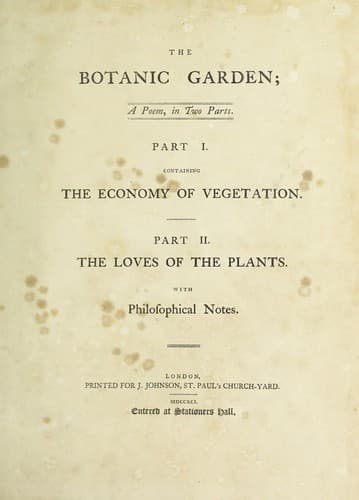
The Botanic Garden. Part 2, Containing the Loves of the Plants. A Poem.: With Philosophical Notes. — John Shaqi
The Botanic Garden. Part 2, Containing the Loves of the Plants. A Poem.: With Philosophical Notes.Darwin, Erasmus
History
The Botanic Garden. Part 2, Containing the Loves of the Plants. A Poem.: With Philosophical Notes.
Darwin, Erasmus
Natural history; Plants -- Poetry
This curious stem is sometimes pushed out of the ground in its horizontal
situation by some of the inferior branches of the root, so as to give it
some resemblance to a Lamb standing on four legs; and has been said to
destroy all other plants in its vicinity. Sir Hans Sloane describes it
under the name of Tartarian Lamb, and has given a print of it. Philos.
Trans. abridged, v. II. p. 646. but thinks some art had been used to
give it an animal appearance. Dr. Hunter, in his edition of the Terra of
Evelyn, has given a more curious print of it, much resembling a sheep.
The down is used in India externally for stopping hemorrhages, and is
called golden moss.
The thick downy clothing of some vegetables seems designed to protect
them from the injuries of cold, like the wool of animals. Those bodies,
which are bad conductors of electricity, are also bad conductors of heat,
as glass, wax, air. Hence either of the two former of these may be melted
by the flame of a blow-pipe very near the fingers which hold it without
burning them; and the last, by being confined on the surface of animal
bodies, in the interstices of their fur or wool, prevents the escape of
their natural warmth; to which should be added, that the hairs themselves
are imperfect conductors. The fat or oil of whales, and other northern
animals, seems designed for the same purpose of preventing the too sudden
escape of the heat of the body in cold climates. Snow protects vegetables
which are covered by it from cold, both because it is a bad conductor of
heat itself, and contains much air in its pores. If a piece of camphor be
immersed in a snow-ball, except one extremity of it, on setting fire to
this, as the snow melts, the water becomes absorbed into the surrounding
snow by capillary attraction; on this account, when living animals are
buried in snow, they are not moistened by it; but the cavity enlarges as
the snow dissolves, affording them both a dry and warm habitation.]
--So, warm and buoyant in his oily mail,
Gambols on seas of ice the unwieldy Whale;
Wide-waving fins round floating islands urge
His bulk gigantic through the troubled surge;
295 With hideous yawn the flying shoals He seeks,
Or clasps with fringe of horn his massy cheeks;
Lifts o'er the tossing wave his nostrils bare,
And spouts pellucid columns into air;
The silvery arches catch the setting beams,
300 And transient rainbows tremble o'er the streams.
Weak with nice sense, the chaste MIMOSA stands,
From each rude touch withdraws her timid hands;
Oft as light clouds o'er-pass the Summer-glade,
Alarm'd she trembles at the moving shade;
305 And feels, alive through all her tender form,
The whisper'd murmurs of the gathering storm;
Shuts her sweet eye-lids to approaching night;
And hails with freshen'd charms the rising light.
Public-domain text, read in full here on John Shaqi.
Reviews
Reviews
No reviews yet
Be the first to share your thoughts on this work.
Join the Discussion
Join the discussion
Sign in to leave a comment or review.
Sign InorCreate an account