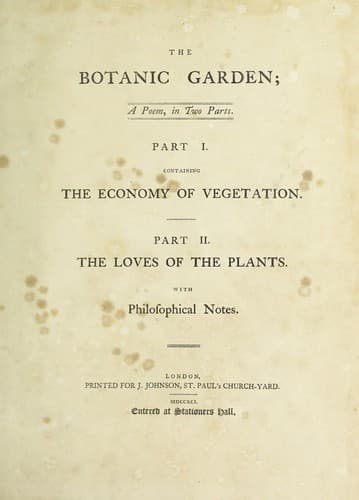
The Botanic Garden. Part 2, Containing the Loves of the Plants. A Poem.: With Philosophical Notes.Darwin, Erasmus
History
The Botanic Garden. Part 2, Containing the Loves of the Plants. A Poem.: With Philosophical Notes.
Darwin, Erasmus
Natural history; Plants -- Poetry
[_Mimosa_. I. 301. The sensitive plant. Of the class Polygamy, one house.
Naturalists have not explained the immediate cause of the collapsing of
the sensitive plant; the leaves meet and close in the night during the
sleep of the plant, or when exposed to much cold in the day-time, in the
same manner as when they are affected by external violence, folding their
upper surfaces together, and in part over each other like scales or
tiles; so as to expose as little of the upper surface as may be to the
air; but do not indeed collapse quite so far, since I have found, when
touched in the night during their sleep, they fall still further;
especially when touched on the foot-stalks between the stems and the
leaflets, which seems to be their most sensitive or irritable part. Now
as their situation after being exposed to external violence resembles
their sleep, but with a greater degree of collapse, may it not be owing
to a numbness or paralysis consequent to too violent irritation, like the
faintings of animals from pain or fatigue? I kept a sensitive plant in
a dark room till some hours after day-break: its leaves and leaf-stalks
were collapsed as in its most profound sleep, and on exposing it to the
light, above twenty minutes passed before the plant was thoroughly awake
and had quite expanded itself. During the night the upper or smoother
surfaces of the leaves are appressed together; this would seem to shew
that the office of this surface of the leaf was to expose the fluids of
the plant to the light as well as to the air. See note on Helianthus.
Many flowers close up their petals during the night. See note on
vegetable respiration in Part I.]
Veil'd, with gay decency and modest pride,
310 Slow to the mosque she moves, an eastern bride;
There her soft vows unceasing love record,
Queen of the bright seraglio of her Lord.--
So sinks or rises with the changeful hour
The liquid silver in its glassy tower.
315 So turns the needle to the pole it loves,
With fine librations quivering as it moves.
All wan and shivering in the leafless glade
The sad ANEMONE reclined her head;
Grief on her cheeks had paled the roseate hue,
320 And her sweet eye-lids dropp'd with pearly dew.
--"See, from bright regions, borne on odorous gales
The Swallow, herald of the summer, sails;
[_Anemone_. l. 318. Many males, many females. Pliny says this flower
never opens its petals but when the wind blows; whence its name: it has
properly no calix, but two or three sets of petals, three in each set,
which are folded over the stamens and pistil in a singular and beautiful
manner, and differs also from ranunculus in not having a melliferous pore
on the claw of each petal. ]
Public-domain text, read in full here on John Shaqi.
Reviews
Reviews
No reviews yet
Be the first to share your thoughts on this work.
Join the Discussion
Join the discussion
Sign in to leave a comment or review.
Sign InorCreate an account