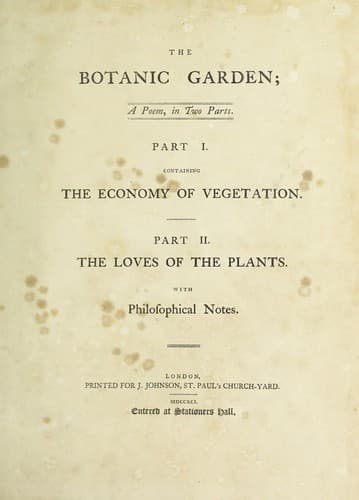
The Botanic Garden. Part 2, Containing the Loves of the Plants. A Poem.: With Philosophical Notes.Darwin, Erasmus
History
The Botanic Garden. Part 2, Containing the Loves of the Plants. A Poem.: With Philosophical Notes.
Darwin, Erasmus
Natural history; Plants -- Poetry
[_The Swallow_. l. 322. There is a wonderful conformity between the
vegetation of some plants, and the arrival of certain birds of passage.
Linneus observes that the wood anemone blows in Sweden on the arrival
of the swallow; and the marsh mary-gold, Caltha, when the cuckoo sings.
Near the same coincidence was observed in England by Stillingfleet. The
word Coccux in Greek signifies both a young fig and a cuckoo, which is
supposed to have arisen from the coincidence of their appearance in Greece.
Perhaps a similar coincidence of appearance in some parts of Asia gave
occasion to the story of the loves of the rose and nightingale, so much
celebrated by the eastern poets. See Dianthus. The times however of the
appearance of vegetables in the spring seem occasionally to be influenced
by their acquired habits, as well as by their sensibility to heat: for the
roots of potatoes, onions, &c. will germinate with much less heat in the
spring than in the autumn; as is easily observable where these roots are
stored for use; and hence malt is best made in the spring. 2d. The grains
and roots brought from more southern latitudes germinate here sooner than
those which are brought from more northern ones, owing to their acquired
habits. Fordyce on Agriculture. 3d. It was observed by one of the scholars
of Linneus, that the apple-trees sent from hence to New England blossomed
for a few years too early for that climate, and bore no fruit; but
afterwards learnt to accommodate themselves to their new situation.
(Kalm's Travels.) 4th. The parts of animals become more sensible to heat
after having been previously exposed to cold, as our hands glow on coming
into the house after having held snow in them; this seems to happen to
vegetables; for vines in grape-houses, which have been exposed to the
winter's cold, will become forwarder and more vigorous than those which
have been kept during the winter in the house. (Kenedy on Gardening.) This
accounts for the very rapid vegetation in the northern latitudes after the
solution of the snows.
The increase of the irritability of plants in respect to heat, after
having been previously exposed to cold, is further illustrated by an
experiment of Dr. Walker's. He cut apertures into a birch-tree at
different heights; and on the 26th of March some of these apertures bled,
or oozed with the sap-juice, when the thermometer was at 39; which same
apertures did not bleed on the 13th of March, when the thermometer was at
44. The reason of this I apprehend was, because on the night of the 25th
the thermometer was as low as 34; whereas on the night of the 12th it was
at 41; though the ingenious author ascribes it to another cause. Trans.
of Royal Soc. of Edinburgh, v. 1. p. 19.]
Public-domain text, read in full here on John Shaqi.
Reviews
Reviews
No reviews yet
Be the first to share your thoughts on this work.
Join the Discussion
Join the discussion
Sign in to leave a comment or review.
Sign InorCreate an account