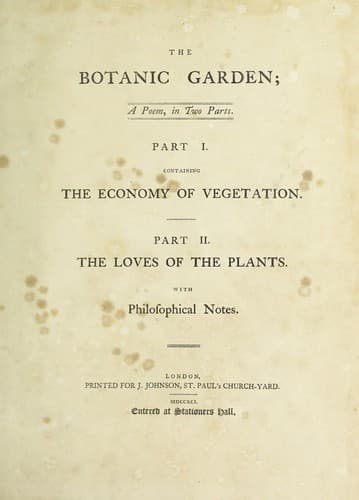
The Botanic Garden. Part 2, Containing the Loves of the Plants. A Poem.: With Philosophical Notes.Darwin, Erasmus
History
The Botanic Garden. Part 2, Containing the Loves of the Plants. A Poem.: With Philosophical Notes.
Darwin, Erasmus
Natural history; Plants -- Poetry
_B._ It is well to know what subjects are within the limits of your
pencil; many have failed of success from the want of this self-knowledge.
But pray tell me, what is the essential difference between Poetry and
Prose? is it solely the melody or measure of the language?
_P._ I think not solely; for some prose has its melody, and even measure.
And good verses, well spoken in a language unknown to the hearer, are not
easily to be distinguished from good prose. _B_. Is it the sublimity,
beauty, or novelty of the sentiments?
_P_. Not so; for sublime sentiments are often better expressed in prose.
Thus when Warwick in one of the plays of Shakespear, is left wounded on
the field after the loss of the battle, and his friend says to him, "Oh,
could you but fly!" what can be more sublime than his answer, "Why then,
I would not fly." No measure of verse, I imagine, could add dignity to
this sentiment. And it would be easy to select examples of the beautiful
or new from prose writers, which I suppose no measure of verse could
improve.
_B_. In what then consists the essential difference between Poetry and
Prose?
_P_. Next to the measure of the language, the principal distinction
appears to me to consist in this: that Poetry admits of but few words
expressive of very abstracted ideas, whereas Prose abounds with them. And
as our ideas derived from visible objects are more distinct than those
derived from the objects of our other senses, the words expressive of
these ideas belonging to vision make up the principal part of poetic
language. That is, the Poet writes principally to the eye, the
Prose-writer uses more abstracted terms. Mr. Pope has written a bad verse
in the Windsor Forest:
"And Kennet swift for silver Eels _renown'd_."
The word renown'd does not present the idea of a visible object to the
mind, and is thence prosaic. But change this line thus,
"And Kennet swift, where silver Graylings _play_."
and it becomes poetry, because the scenery is then brought before the
eye.
_B_. This may be done in prose.
_P_. And when it is done in a single word, it animates the prose; so it
is more agreeable to read in Mr. Gibbon's History, "Germany was at this
time _over-shadowed_ with extensive forests;" than Germany was at this
time _full_ of extensive forests. But where this mode of expression
occurs too frequently, the prose approaches to poetry: and in graver
works, where we expect to be instructed rather than amused, it becomes
tedious and impertinent. Some parts of Mr. Burke's eloquent orations
become intricate and enervated by superfluity of poetic ornament; which
quantity of ornament would have been agreeable in a poem, where much
ornament is expected.
_B_. Is then the office of poetry only to amuse?
Public-domain text, read in full here on John Shaqi.
Reviews
Reviews
No reviews yet
Be the first to share your thoughts on this work.
Join the Discussion
Join the discussion
Sign in to leave a comment or review.
Sign InorCreate an account