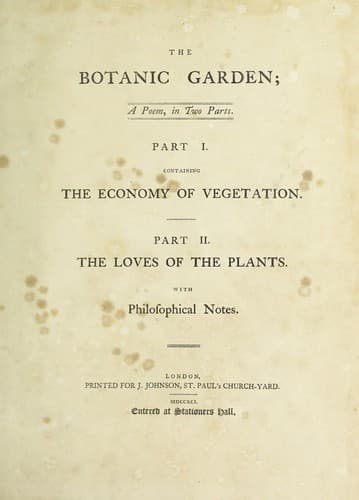
The Botanic Garden. Part 2, Containing the Loves of the Plants. A Poem.: With Philosophical Notes. — John Shaqi
The Botanic Garden. Part 2, Containing the Loves of the Plants. A Poem.: With Philosophical Notes.Darwin, Erasmus
History
The Botanic Garden. Part 2, Containing the Loves of the Plants. A Poem.: With Philosophical Notes.
Darwin, Erasmus
Natural history; Plants -- Poetry
_P_. The Muses are young ladies, we expect to see them dressed; though
not like some modern beauties with so much gauze and feather, that "the
Lady herself is the least part of her." There are however didactic pieces
of poetry, which are much admired, as the Georgics of Virgil, Mason's
English Garden, Hayley's Epistles; nevertheless Science is best delivered
in Prose, as its mode of reasoning is from stricter analogies than
metaphors or similies.
_B_. Do not Personifications and Allegories distinguish poetry?
_P_. These are other arts of bringing objects before the eye; or of
expressing sentiments in the language of vision; and are indeed better
suited to the pen than the pencil.
_B_. That is strange, when you have just said they are used to bring
their objects before the eye.
_P_. In poetry the personification or allegoric figure is generally
indistinct, and therefore does not strike us as forcibly as to make us
attend to its improbability; but in painting, the figures being all much
more distinct, their improbability becomes apparent, and seizes our
attention to it. Thus the person of Concealment is very indistinct and
therefore does not compel us to attend to its improbability, in the
following beautiful lines of Shakespear:
"--She never told her love;
But let Concealment, like a worm i' th' bud,
Feed on her damask cheek."--
But in these lines below the person of Reason obtrudes itself into our
company, and becomes disagreeable by its distinctness, and consequent
improbability.
"To Reason I flew, and intreated her aid,
Who paused on my case, and each circumstance weigh'd;
Then gravely reply'd in return to my prayer,
That Hebe was fairest of all that were fair.
That's a truth, reply'd I, I've no need to be taught,
I came to you, Reason, to find out a fault.
If that's all, says Reason, return as you came,
To find fault with Hebe would forfeit my name."
Public-domain text, read in full here on John Shaqi.
Reviews
Reviews
No reviews yet
Be the first to share your thoughts on this work.
Join the Discussion
Join the discussion
Sign in to leave a comment or review.
Sign InorCreate an account