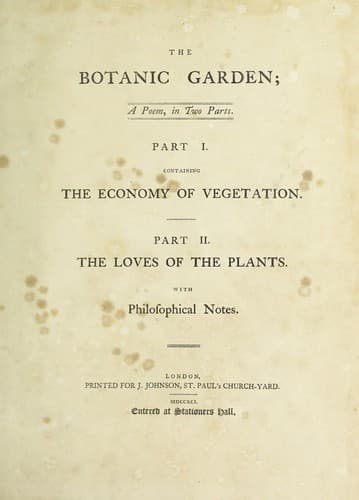
The Botanic Garden. Part 2, Containing the Loves of the Plants. A Poem.: With Philosophical Notes.Darwin, Erasmus
History
The Botanic Garden. Part 2, Containing the Loves of the Plants. A Poem.: With Philosophical Notes.
Darwin, Erasmus
Natural history; Plants -- Poetry
There are two circumstances, which contribute to this compleat deception
in our dreams. First, because in sleep the organs of sense are closed or
inert, and hence the trains of ideas associated in our imaginations are
never interrupted or dissevered by the irritations of external objects,
and can not therefore be contrasted with our sensations. On this account,
though we are affected with a variety of passions in our dreams, as
anger, love, joy; yet we never experience surprize.--For surprize is only
produced when any external irritations suddenly obtrude themselves, and
dissever our passing trains of ideas.
Secondly, because in sleep there is a total suspension of our voluntary
power, both over the muscles of our bodies, and the ideas of our minds;
for we neither walk about, nor reason in compleat sleep. Hence, as the
trains of ideas are passing in our imaginations in dreams, we cannot
compare them with our previous knowledge of things, as we do in our
waking hours; for this is a voluntary exertion; and thus we cannot
perceive their incongruity. Thus we are deprived in sleep of the only
two means by which we can distinguish the trains of ideas passing in our
imaginations, from those excited by our sensations; and are led by their
vivacity to believe them to belong to the latter. For the vivacity of
these trains of ideas, passing in the imagination, is greatly increased
by the causes above-mentioned; that is, by their not being disturbed or
dissevered either by the appulses of external bodies, as in surprize; or
by our voluntary exertions in comparing them with our previous knowledge,
of things, as in reasoning upon them.
_B_. Now to apply.
_P_. When by the art of the Painter or Poet a train of ideas is suggested
to our imaginations, which interests us so much by the pain or pleasure
it affords, that we cease to attend to the irritations of common external
objects, and cease also to use any voluntary efforts to compare these
interesting trains of ideas with our previous knowledge of things, a
compleat reverie is produced: during which time, however short, if it be
but for a moment, the objects themselves appear to exist before us. This,
I think, has been called by an ingenious critic "the ideal presence" of
such objects. (Elements of Criticism by Lord Kaimes). And in respect to
the compliment intended by Mr. Fielding to Mr. Garrick, it would seem
that an ignorant Rustic at the play of Hamlet, who has some previous
belief in the appearance of Ghosts, would sooner be liable to fall into
reverie, and continue in it longer, than one who possessed more knowledge
of the real nature of things, and had a greater facility of
exercising his reason.
_B_. It must require great art in the Painter or Poet to produce this
kind of deception?
Public-domain text, read in full here on John Shaqi.
Reviews
Reviews
No reviews yet
Be the first to share your thoughts on this work.
Join the Discussion
Join the discussion
Sign in to leave a comment or review.
Sign InorCreate an account